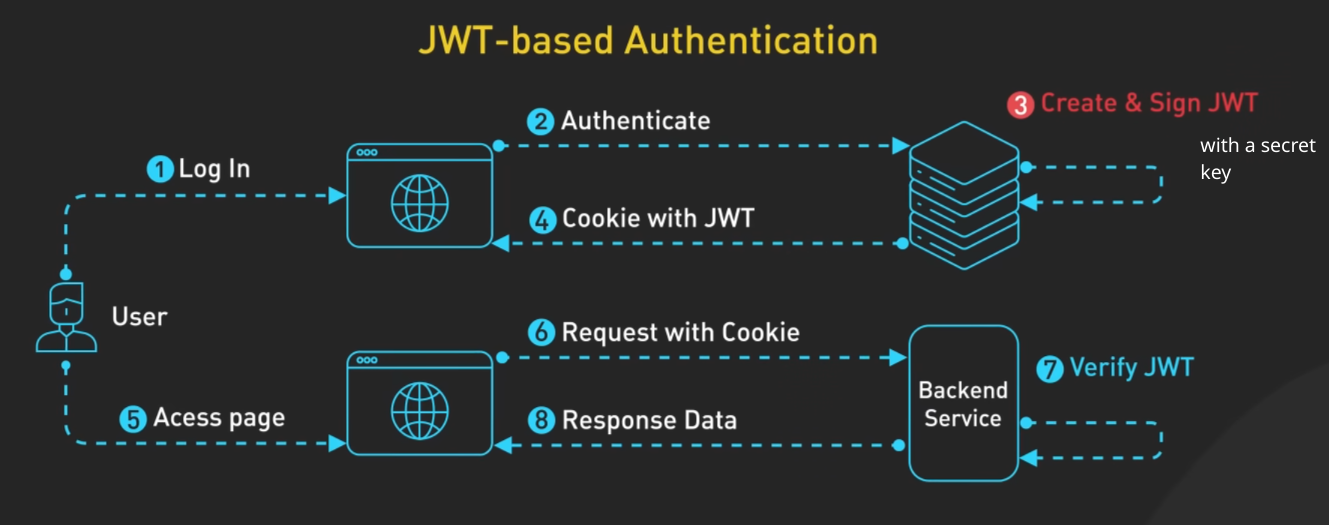
jwt is stateless (access/refresh? tokens are stored in client)
signing key by symmetric signing method
token expiration
refresh token
RT is stateful (stored in DB in dedicated RT table) , AT is stateless
expiration days/weeks
only sent to server when access token is expired -> avoid log in again
created with access token simultaneously
refresh token is stored in DB (not access token). if access token is expired, client send refresh token to renew access token. server checks refresh token from DB, if RT is existing in DB, server deletes it and creates both RT/AT (RT keeps expiration date) -> server creates new RT/AT pair to avoid (Refresh) Token Theft
if RT is expired -> logout
if user wants to logout -> server delete RT in DB
(short-lived) access token
expiration ~15 mins
reduce authentication time (not query DB)
revoke access token?
why not increase AT lifetime to match RT (replace RT)?
AT (from JWT) is stateless and self-contained, so server cannot check that AT is revoked or not
what happens when user clicks log-out button?
client sends RT to server to delete RT without returning new AT
user can use AT for a short time (~15m)
comparison
Feature
Session-Based Authentication (SB)
OAuth with JWT Access Tokens (AT)
Authentication Type
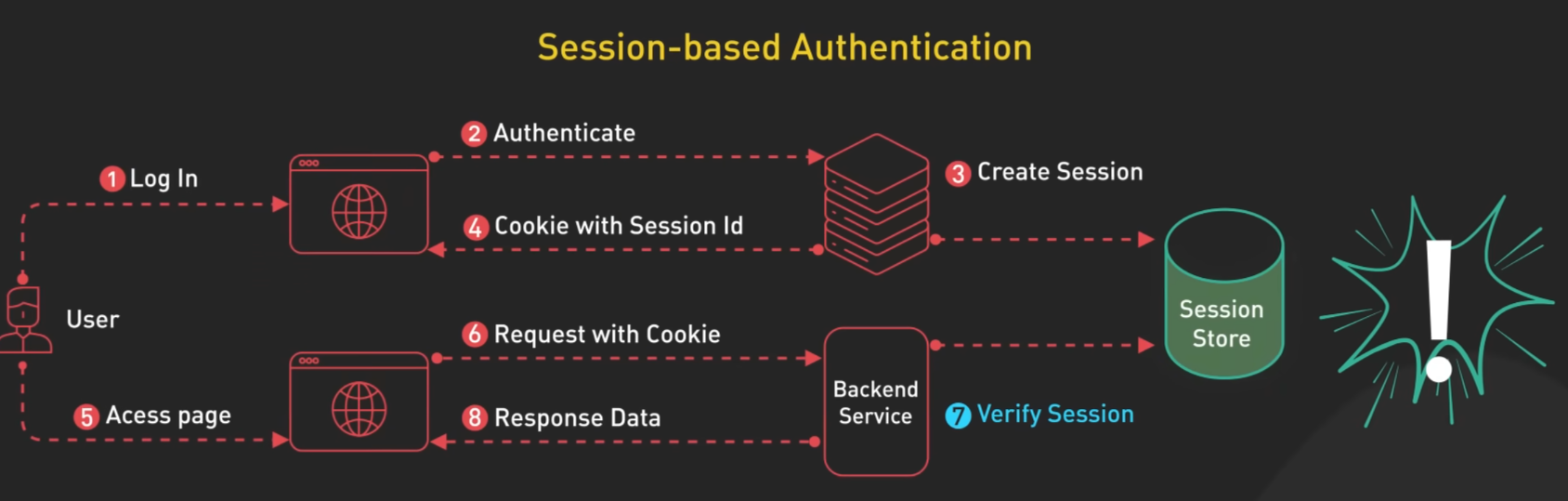
Stateful (Server maintains the “state” of the session)
Stateless (Session state is in the token itself)
The Credential
Session ID (a meaningless random string) in a cookie.
Access Token (AT) which is typically a self-contained JWT.
Validation Flow
For every request, the server must look up the Session ID in the Session Store/DB to find the user’s data.
For every request, the server verifies the JWT’s cryptographic signature using a secret key. No DB lookup is required for the AT.
Scalability
Poor: Requires a central, shared, and highly available session store (DB/Redis) that every server must hit, creating a bottleneck.
Excellent: API servers are independent (stateless). They can validate tokens on their own, making it easy to scale horizontally.
Revocation
Instant: Deleting the session ID from the DB immediately invalidates it.
Delayed: Must wait for the short-lived AT to expire. Revocation is handled by the Refresh Token (RT).
 ;
;