Transactional Outbox Pattern
Problem
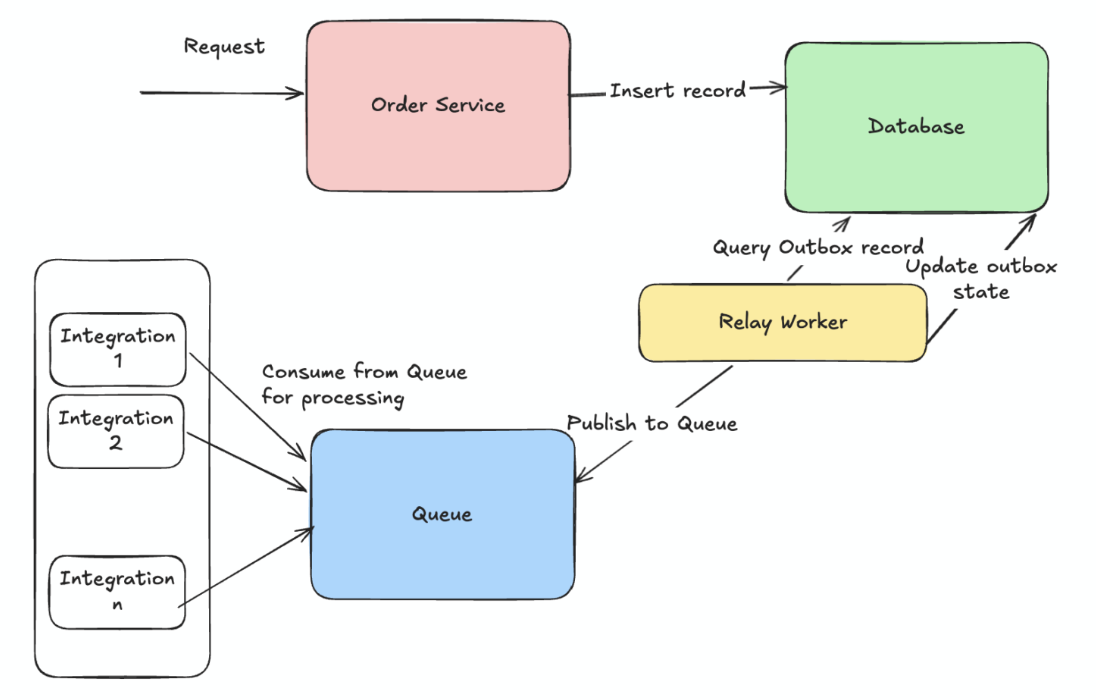
In distributed systems, writing to a database and publishing a message to a broker (Kafka, RabbitMQ) are two separate operations. A crash between them causes:
- DB write committed, event never published → downstream out-of-sync
- Event published, DB write rolled back → phantom event with no backing state
Solution
Write the event into an outbox_events table in the same DB transaction as the domain write. A separate process reliably polls and publishes the outbox rows to the broker. The broker delivery is decoupled from the domain write.
[Service] ──── @Transactional ────────────────────────────────┐
                  ├── INSERT INTO reservations …              │
                  └── INSERT INTO outbox_events …             │
            ──────────────────────────────────────────────────┘
                                   ↓ (commit)
[OutboxPoller] ── FOR UPDATE SKIP LOCKED ──→ Kafka ──→ Consumer
Event Model
// outbox-lib: OutboxEvent.java
@Value @Builder
class OutboxEvent {
    UUID id;
    UUID aggregateId;      // root entity (e.g. reservationId)
    String aggregateType;  // e.g. "Reservation", "Payment"
    String eventType;      // e.g. "BookingCreated", "PaymentCaptured"
    String payload;        // JSON string
    Instant createdAt;
    Instant publishedAt;   // null until dispatched
}
DB Schema
CREATE TABLE outbox_events (
  id             UUID        PRIMARY KEY DEFAULT gen_random_uuid(),
  aggregate_id   UUID        NOT NULL,
  aggregate_type VARCHAR(100) NOT NULL,
  event_type     VARCHAR(200) NOT NULL,
  payload        JSONB       NOT NULL,
  created_at     TIMESTAMPTZ NOT NULL DEFAULT NOW(),
  published_at   TIMESTAMPTZ           -- NULL until published
);

-- Partial index: only unpublished rows; poller query hits this exactly
CREATE INDEX idx_outbox_unpublished ON outbox_events (created_at)
  WHERE published_at IS NULL;
Delivery Modes
1. Polling (Pull)
The outbox library ships a @Scheduled poller that runs inside a transaction:
every fixedDelay (default 1s):
  BEGIN TRANSACTION
    SELECT … WHERE published_at IS NULL
      ORDER BY created_at
      FOR UPDATE SKIP LOCKED      ← concurrent-safe, no double-send
      LIMIT 50
    for each event:
      kafkaTemplate.send(topic, aggregateId, payload).get()  ← synchronous
      if success: add to successIds
      if InterruptedException: restore interrupt, break
      if other error: log warn, skip (retry next poll)
    UPDATE outbox_events SET published_at = NOW()
      WHERE id = ANY(successIds::uuid[])
  COMMIT
Key choices:
fixedDelay(notfixedRate) — delay counts from job completion, prevents overlap for variable-duration batches- Synchronous
.get()— blocks until Kafka broker acks; at-least-once guarantee (row stays unpublished on timeout) - Partial success — only successfully sent IDs are marked; failed events remain for next cycle
FOR UPDATE SKIP LOCKED— multiple poller instances (replicas) can run safely; each locks a disjoint set of rows
2. CDC via Debezium (Push)
An alternative where published_at is never written. Debezium reads the WAL and streams inserts directly.
Connector config (scripts/debezium/outbox-connector.json):
{
  "connector.class": "io.debezium.connector.postgresql.PostgresConnector",
  "plugin.name": "pgoutput",
  "slot.name": "outbox_slot",
  "publication.name": "outbox_publication",
  "table.include.list": "public.outbox_events",
  "tombstones.on.delete": "false",
  "transforms": "outbox",
  "transforms.outbox.type": "io.debezium.transforms.outbox.EventRouter",
  "transforms.outbox.table.field.event.key": "aggregate_id",
  "transforms.outbox.table.field.event.payload": "payload",
  "transforms.outbox.route.by.field": "event_type",
  "transforms.outbox.route.topic.replacement": "${routedByValue}"
}
Topic routing: each row’s event_type becomes the Kafka topic name directly (e.g. event_type='BookingCreated' → topic BookingCreated). No prefix is prepended by the Event Router SMT.
Polling vs CDC comparison:
| Polling | CDC (Debezium) | |
|---|---|---|
| Delivery | At-least-once (synchronous .get()) | At-least-once (WAL) |
| Latency | Configurable (poll.interval-ms) | Near-realtime |
published_at | Written after send | Never written |
| Extra infra | None | Debezium + logical replication slot |
| DB load | Periodic SELECT + UPDATE | WAL reads only |
Library Integration (outbox-lib)
Auto-configures via OutboxAutoConfiguration (@ConditionalOnClass(DSLContext.class)). All beans are @ConditionalOnMissingBean — override any by providing your own.
Adopting in a service:
- Add
outbox-libMaven dependency - Add
"classpath:db/outbox"toFlywayConfigmigration locations (createsoutbox_events) - Add
spring-kafkadependency + Kafka producer config - Inject
OutboxEventRepositoryinto your@Transactionalwriter service - Call
outboxEventRepository.save(OutboxEvent)in the same transaction as your domain write
// booking-service: ReservationWriter.java
@Service
class ReservationWriter {

    @Transactional
    Reservation writeReservation(CreateReservationCommand cmd) {
        quoteRepository.markUsed(cmd.quoteId());           // idempotency guard
        Reservation saved = reservationRepository.save(…); // domain write
        outboxEventRepository.save(OutboxEvent.builder()   // outbox write
            .aggregateId(saved.getId())
            .aggregateType("Reservation")
            .eventType("BookingCreated")
            .payload(objectMapper.writeValueAsString(Map.of(
                "reservationId", saved.getId(),
                "userId", saved.getUserId(),
                …
            )))
            .build());
        return saved;
    }
}
Event types emitted per service:
| Service | Event Types |
|---|---|
| booking-service | BookingCreated, BookingConfirmed, BookingCancelled, RefundFailed |
| payment-service | PaymentAuthorized, PaymentCaptured, PaymentRefunded, PaymentCancelled, PaymentFailed |
In the Project (atomic-book)
Both delivery modes coexist. They share the same DB table, the same domain model, and the same port/out interface — only the publisher differs.
Shared Infrastructure
outbox_events table (public schema)
       ↑ write (same for both modes)
OutboxEventRepository (port/out interface)
       ↑ inject
ReservationWriter / PaymentWriter (@Transactional service)
       └── reservationRepository.save(...)
       └── outboxEventRepository.save(...)   ← same call regardless of delivery mode
The service code that writes to the outbox is identical whether polling or CDC is configured downstream. The delivery mechanism is entirely transparent to the writer.
Polling Path (default, enabled by outbox-lib)
OutboxAutoConfiguration
  → OutboxPollingPublisher (@Scheduled, fixedDelay=1s)
      → OutboxEventJooqRepository.findUnpublishedBatch(50)
          SELECT … WHERE published_at IS NULL FOR UPDATE SKIP LOCKED LIMIT 50
      → KafkaTemplate.send(eventType, aggregateId, payload).get()
      → OutboxEventJooqRepository.markPublished([ids])
          UPDATE outbox_events SET published_at = NOW() WHERE id = ANY(?)
published_at is the delivery marker. Undelivered rows have published_at IS NULL and will be retried on the next poll cycle.
CDC Path (Debezium, enabled by scripts/debezium/register-connector.sh)
PostgreSQL WAL (logical replication, pgoutput plugin)
  → Debezium outbox connector (slot: outbox_slot)
      → EventRouter SMT
          route.by.field=event_type
          route.topic.replacement=${routedByValue}
      → Kafka topic (name = event_type value, e.g. "BookingCreated")
published_at is never written. Debezium tracks its WAL offset in the replication slot; the outbox_events rows are append-only. Re-delivery on restart is handled by replaying from the last committed WAL offset.
What They Share
| Polling | CDC | |
|---|---|---|
| Outbox table | Same public.outbox_events | Same public.outbox_events |
| Domain model | OutboxEvent | OutboxEvent |
| Port interface | OutboxEventRepository | OutboxEventRepository |
| Writer code | Identical outboxEventRepository.save(...) | Identical outboxEventRepository.save(...) |
| Topic naming | eventType field → Kafka topic | event_type column → Kafka topic (via SMT) |
| Kafka key | aggregateId.toString() | aggregate_id column (via SMT table.field.event.key) |
| Payload | payload field (JSON string) | payload column (JSONB, delivered as string) |
| Delivery guarantee | At-least-once | At-least-once |
What Differs
| Polling | CDC | |
|---|---|---|
| Delivery marker | published_at timestamp (written on success) | WAL offset in replication slot (never touches rows) |
| Latency | Up to poll.interval-ms (default 1 000 ms) | Near-realtime (WAL tail latency, typically < 100 ms) |
| Retry on crash | Rows with published_at IS NULL are retried on next poll | WAL offset rolled back; events re-streamed from last committed position |
| Duplicate risk | Poll transaction committed, Kafka ack lost → row already marked → no duplicate | WAL replayed from offset → duplicate if consumer not idempotent |
| DB write amplification | Extra UPDATE published_at per batch | None — rows are append-only |
| Infrastructure | None beyond the app | Debezium Connect cluster + Postgres logical replication slot |
| Replication slot risk | None | Unconsumed slot holds WAL indefinitely → disk exhaustion if Debezium lags |
| Ordering | ORDER BY created_at in SELECT | WAL order (insertion order) — same in practice |
| Schema flexibility | Can add routing logic in TopicResolver bean | Routing is SMT config; changing requires connector restart |
| Outbox table growth | Rows accumulate; needs a periodic DELETE WHERE published_at IS NOT NULL cleanup job | Rows accumulate; same cleanup needed |
Which Mode Is Active When
- Development / default: polling only.
OutboxAutoConfigurationactivates automatically whenDSLContextandspring-kafkaare on the classpath.published_atis written after each send. - Production (with Debezium):
scripts/debezium/register-connector.shregisters the connector. Both modes can technically run simultaneously — polling still marks rows while CDC also streams them — so in practice, disable the polling publisher (outbox.polling.enabled=falseor remove thespring-kafkaproducer config) when running CDC to avoid double-publishing. - Testing: polling mode only; Debezium is not started in
BaseIntegrationTest. The test Kafka container receives events via the polling publisher.
Consumer Idempotency Requirement
Both modes deliver at-least-once. Consumers must be idempotent:
- Use the
OutboxEvent.id(UUID) as a deduplication key idempotency-lib’s two-phase store (INSERT ON CONFLICT DO NOTHING) is the recommended approach for any consumer that performs a DB write in response to an event- For notification-service (email/SMS send), natural idempotency via per-user/per-event deduplication keys is sufficient
Relation to CQRS and Inline Projection
The outbox pattern and inline projection are two different responses to the same underlying question: how do you keep a second piece of state consistent with the first?
Dual-Write in One Transaction
Both patterns solve their consistency problem using the same mechanism — writing two things atomically in one DB transaction:
Outbox:
  BEGIN TRANSACTION
    INSERT INTO reservations …          ← domain write
    INSERT INTO outbox_events …         ← event relay (for broker delivery)
  COMMIT

Inline Projection:
  BEGIN TRANSACTION
    INSERT INTO reservations …          ← domain write
    UPSERT INTO booking_summary_view …  ← read model (for queries)
  COMMIT
The structural pattern is identical. The intent differs:
| Outbox write | Inline projection write | |
|---|---|---|
| Target | outbox_events relay table | Query-optimised read model table |
| Consumer | External services via Kafka (async) | Same service’s query layer (sync) |
| Consistency | Eventual — after broker delivery | Immediate — visible after commit |
| Coupling | Write side decoupled from read schema | Write side knows read schema |
| Infrastructure | Broker + poller/CDC | None beyond the DB |
Outbox as the Bridge for Async Projections
In a CQRS architecture, async projections need a reliable way to receive write-side events. The outbox is that bridge:
Write Side                 Outbox                   Read Side
──────────                 ──────                   ─────────
INSERT reservation  →  INSERT outbox_event  →  [Poller/CDC]
(same transaction)                              → Kafka
                                                → ProjectionConsumer
                                                    → UPSERT read model
Without the outbox, publishing directly to Kafka inside a transaction is unsafe — the broker call can fail after the DB commits, leaving the event permanently lost. The outbox guarantees the event is delivered if the transaction committed, making async projections reliable.
Choosing Between Them
Use inline projection when:
- The read model is owned by the same service as the write model
- Immediate consistency is required (user sees their change right away)
- The projection is simple (one or two extra rows)
Use outbox + async projection when:
- The read model belongs to a different service or bounded context
- Multiple consumers need independent views of the same event
- Eventual consistency is acceptable
In atomic-book, notification-service is the clearest example of outbox-driven async projection: booking-service emits BookingConfirmed via outbox → Kafka → notification-service builds its dispatch queue. The write side (booking) has no knowledge of the read side (notification).
Ports & Adapters
application/port/out/OutboxEventRepository     ← port interface
adapter/out/persistence/OutboxEventJooqRepository  ← jOOQ impl
outbox/publisher/OutboxPollingPublisher        ← @Scheduled poller
outbox/config/OutboxAutoConfiguration          ← Spring auto-config
Gotchas
publication.autocreate.mode: filtered fails if table missing — use all_tables until Flyway has run and created outbox_events.
Payload must be serialized JSON, never String.format — use objectMapper.writeValueAsString(Map.of(...)). String formatting silently produces invalid JSON on special characters.
Map.of() rejects null values — use LinkedHashMap for payloads with conditionally present fields.
Event DTOs belong in application/port/in/event/ — not in adapter/in/kafka/. Application services must not import adapter packages.
Kafka event DTOs must carry an explicit userId — never pass a related entity ID (e.g. bookingId) where userId is required; the consuming service can’t look it up.
Outbox Flyway migration must use a separate history table — outbox-lib, idempotency-lib, and the service each ship V1. Use three Flyway beans pointing to distinct flyway_schema_history_<name> tables. Secondary beans need baselineOnMigrate(true) + baselineVersion("0").
Debezium Event Router SMT topic routing — route.topic.replacement=${routedByValue} routes to the topic named exactly after event_type; no topic.prefix is prepended. Don’t confuse this with the connector-level topic.prefix (used only for non-outbox tables).