SQL or relational DB are row-store, describes the relation between objects. it is organized with schemas and tables.
all records in a table have same structure, follow same constraints
guarantees ACID characteristics
noSQL
store data in more free forms, compared to SQL
some main types:
key-value: redis, memcache,
difference between redis and memcached?
redis: use single thread, supports more data structures
memcached: support multiple processing/threading, store data in string format
document: mongodb
columnar: cassandra
graph: neo4j
…
architecture
standalone
master - slave:
1 server is master server, and others are slave servers (data replication). write operations are only executed on master server, read operations are distributed between servers
when a server is down, a new server will be created with same data. if master server is down, one of slave servers is promoted as master, and a new slave server is created
cluster?
redis:
scaling?
usually scale up vertically (add more CPUs, memory, storage)
some databases support horizontal scaling (add/remove more servers to scale up/down). eg. cassandra supports horizontal scaling with consistent hashing
What is a transaction in SQL? When is a transaction considered successful?
a transaction is a unit of work, contains one or more operations. an executed transaction changes database from current state to another state.
when a transaction is successful, all its operations have to run completely, without any error. if any operation is failed, a transaction is failed
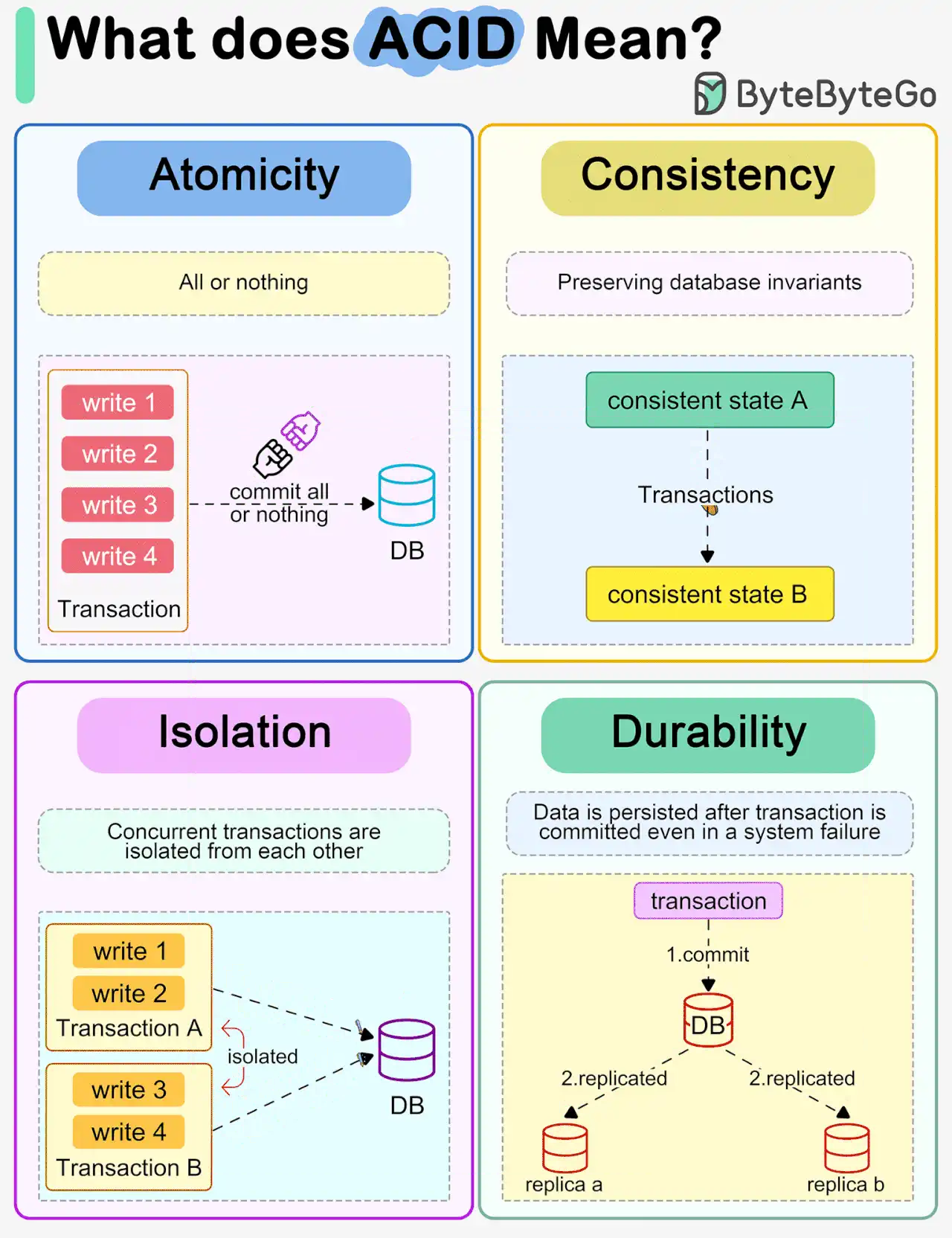
ACID
are properties of transaction
A - atomicity
all of transaction’s operations must be executed or not together, this ensures that no transaction is completed partially -> transaction is single unit
C - consistency
keep data consistent before and after executing transaction -> a transaction change data from a consistent state to another consistent state
consistent state is state where data meets all constraints, rules and relationships defined in schema
I - isolation
2 transactions must not interfere with each other (use same data at the same time)
D - durability
the changes made by a completed transaction is permanent. it ensures that the consistent state after executing transaction can be recovered after any system failure or crash
CAP
consistency: all clients see same the data at the same time no matter which server is connected
availability: always get data even one or more servers are down
partition tolerance: the system continues to operate despite network partitions (disconnection between network’s components)
-> in distributed system, partitions cannot be avoided, and we have to choose between consistency and availability
if choose cp system (eg. bank, …): - reject all write operations (which cause data inconsistency) - return error before inconsistency is resolved (system is unavailable)
if choose ap system: - accept write operations to running servers - sync new data to new servers after partition is resolved
SQL normalizations - 4 common types of normalization
doc
set of specific rules for improving design of database
1st
each attribute (table’s cell) contains only one (singular) value -> eliminate duplicated data and simplify queries
2nd
non-key attributes must be fully dependent on entire primary-key (not partial dependency)
3rd
there is not transitive dependencies between attributes, a non-key attribute is not functionally dependent on another non-key attribute
boyce-codd (3rd+)
every determinant (a attribute can be used to determine value of other attributes) is a candidate key (uniquely identify rows)
Data sharding
Indexing
requires own disk space and holds a copy of data -> redundant data
creating index does not change data
Database models
flat model
store data in table (row - record/entity, column - attribute) -> lack of ability to handle relationship between entities
hierarchical model
store data in tree-like data structure -> struggles with many-to-many relationships
relational model
represents data in tables (relations) -> support data integrity, avoid redundancy, support many-to-many relationships, and complex queries and transactions