basic concepts and theorems
partitioning
- split DB into multiple smaller datasets and store them in different nodes
- vertical splitting
- multiple tables with fewer columns
- horizontal splitting (sharding)
- stores a percentage of rows of initial tables -> potential for loss of transaction semantics
- range partitioning
- hash partitioning
- consistent hashing
- potential of non-uniform distribution of data (imbalance)
replication
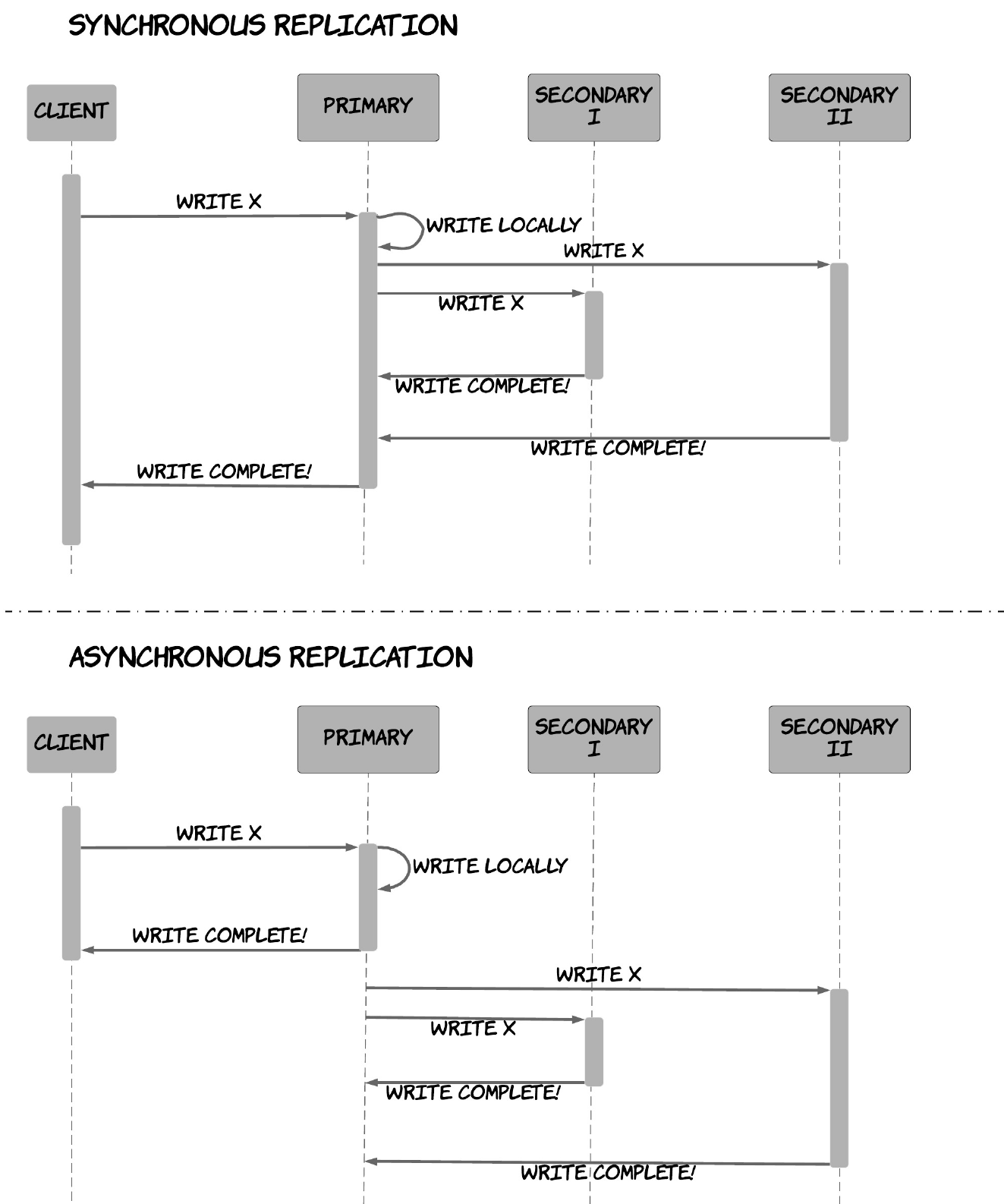
- increase availability by copying data to other nodes (data must be maintained and kept in sync)
- pessimistic replication
- keep replicas identical to each other
- optimistic (lazy) replication - eventually consistency
- allow replicas diverge, and converge again if they don’t receive update for a period of time
(single) master-slave
- 1 node is master (writable) and other nodes are slave (readable)
multi-master
- prefer high availability and performance to data consistency
- all nodes are writable/readable -> conflicts
- expose conflict resolution to clients
- last-write-wins (local clock?) -> unexpected behaviors
- causality tracking algorithm
quorums
- quorum condition
- Qr (quorum of read) + Qw (quorum of write) > N (number of nodes)
- Qw > N/2
- why Qr > N/2 needn’t?
- Vr needn’t be a majority but large enough to collide every possible write quorum
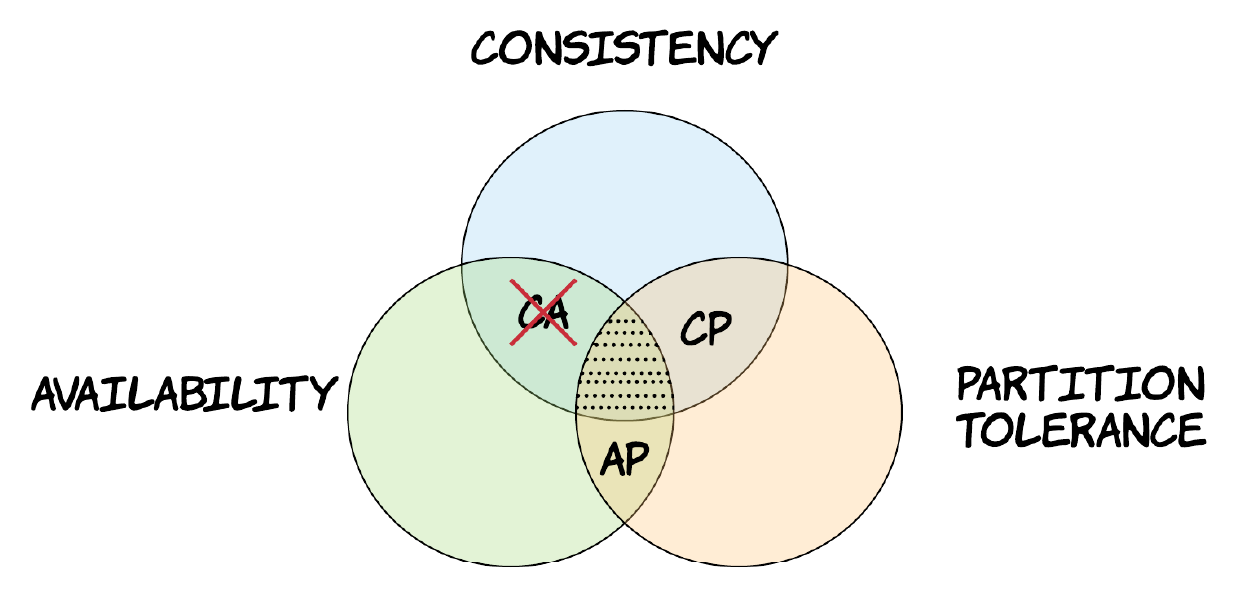
CAP theorem
PACELC theorem
- extend CAP
- in case of network partition (P), system has to choose between availability (A - AP) and consistency (C - CP), else (E) system has to choose between latency (L) and consistency (C)
consistency / isolation
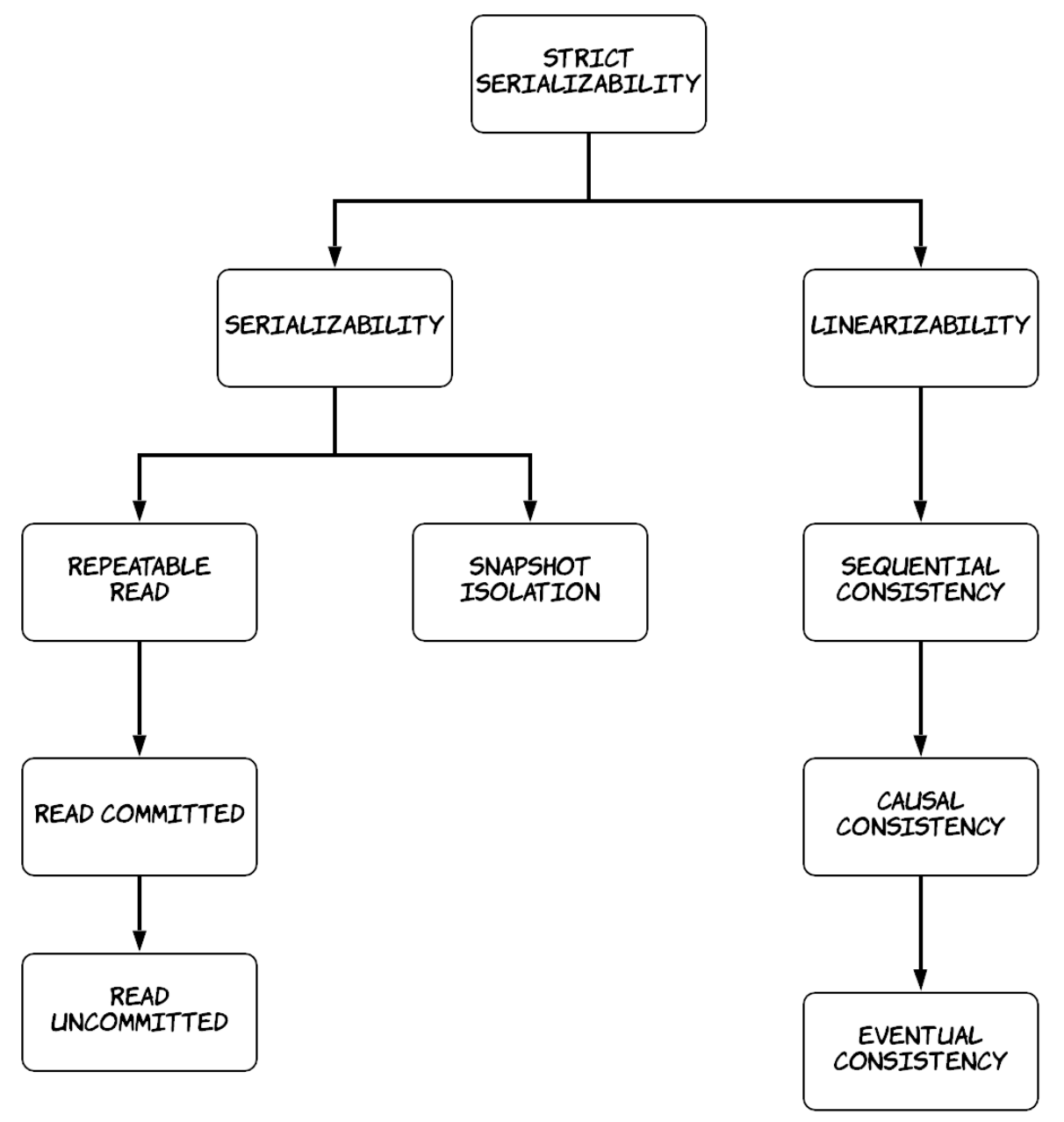
consistency model
- linearizability = strong consistency
- synchronous replication
- operations appear to be instantaneous to external clients (subsequent reads will see the result of latest write) when thinking about a distributed system as a single node
- writes take longer (propagate to other nodes)
- is consistency C in CAP theorem (give up availability A in CAP)
- sequential consistency
- no realtime guarantee
- all operations must be seen in the same order (global order)
- causal consistency
- only operations that are causally related need to be seen in the same order (not global order)
- eventual consistency (a weak consistency model, not a synonym for the whole category)
- no guarantee for order of operations, only that replicas converge if updates stop
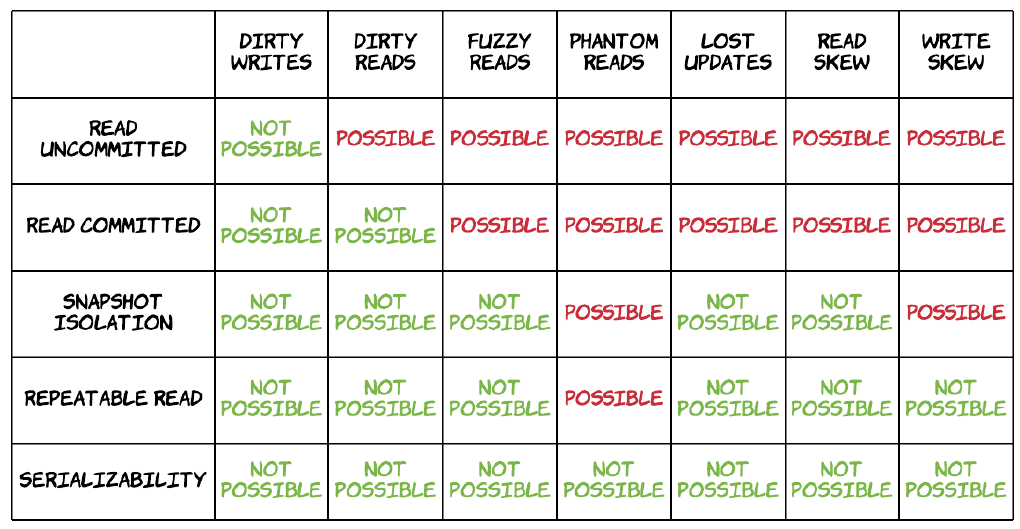
isolation level
-
anomalies
- dirty writes
- a transaction overwrites a value that has previously been written by another transaction that is not committed -> violate integrity -> no rollback
- dirty reads
- a transaction reads a value that has been written by another transaction that has not been committed
- non-repeatable reads
- a transaction reads a value twice with different values (acting on stale data)
- phantom reads
- a transaction does a predicate-based read (query) and another transaction updates matched items while the first transaction is running
- lost updates
- 2 transactions read the same value and try to update with different value
- read skew
- a transaction can only see partial result of another transaction
- write skew
- 2 transactions read the same data but modify disjoint set of data
- dirty writes
-
serializability
-
repeatable read
-
snapshot isolation
- all reads made in a transaction will see a consistent snapshot of the database from the point it starts. it will commit successfully if no other transaction has updated the same data since that snapshot (first-committer-wins)
- prevents dirty reads, non-repeatable reads, read skew and lost updates, but NOT write skew (the 2 transactions touch disjoint data, so there is no write-write conflict to detect)
-
read committed
-
read uncommitted
distributed transactions
- performing some operations across multiple nodes in an atomic way
- 2 variants
- same piece of data need to be updated in multiple replicas
- different pieces of data residing in different nodes need to be updated atomically
ACID of DB transaction
- Atomicity: a transaction composed of multiple operations is treated as a single unit (all or none) -> no partial failure
- Consistency: a transaction only transitions DB from 1 valid state to another valid state, maintaining DB invariants
- Isolation: if transactions happen at a time, there is no interference between them
- Durability: once transaction is committed, it will remain committed even in the case of failure
isolation
- 2 mechanisms for concurrency control
- pessimistic concurrency control: block a transaction if it is expected to cause violation, resume it when it is safe (reduce number of aborts/restarts of transactions)
- optimistic concurrency control: delay the checking until the end of the transaction (a transaction is aborted if a commit violate any rule)
2-phase locking (2PL)
- a pessimistic concurrency control using locks to prevent transactions from interfering
- 2 types of lock
- write (exclusive) lock: acquired when a record is going to be written, block both read and write from another transaction
- read (shared) lock: acquired when a record is read, blocks write from another transaction (multiple read locks can be acquired at the same time)
- 2 phases
- expanding phase: acquire locks (without releasing)
- shrinking phase: release locks (without acquiring)
- 2PL guarantees serializability. strict 2PL (hold all locks until commit/abort) additionally avoids cascading aborts
snapshot isolation via multiversion concurrency control (MVCC)
- MVCC itself is a storage technique (keep multiple versions of each record), not a concurrency-control discipline -> reads are never blocked by other transactions that are updating same data
- it underpins optimistic schemes (snapshot isolation with first-committer-wins) and pessimistic ones alike (2PL for writers + MVCC snapshot readers, e.g. SQL Server RCSI)
- snapshot isolation on top of MVCC is optimistic: the write-conflict check is deferred to commit time
- how it works?
- DB keeps 2 timestamps of a transaction Tstart, Tend
- DB reads version of record that has committed time <= Tstart, accepts write if latest version of record <= Tstart (no change)
atomicity
2-phase commit protocol (2PC)
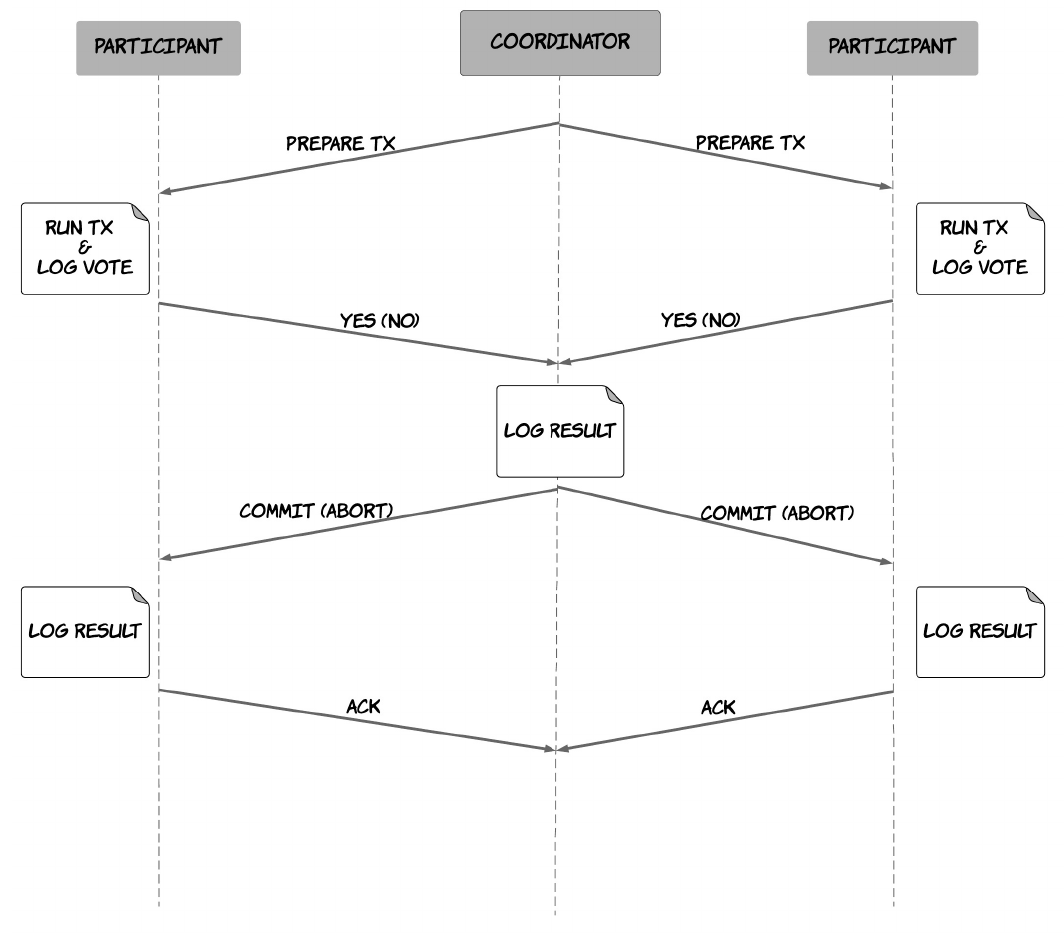
- 2 roles
- coordinator
- participants
- 2 phases
- voting phase
- coordinator sends the transaction to all participants. participants execute transaction and are supposed to commit, and send their votes to coordinator
- commit phase
- coordinator gathers all votes from participants. coordinator sends instruction to all participants to commit (all votes are yes)/abort (any vote is no) transaction
- if a participant fails before receiving coordinator’s instruction, it recovers and communicates with coordinator to find out result of pending transaction
- voting phase
- coordinator and all participants keep decision in write-ahead-log (WAL) to recover in case of failure
- coordinator is single point of failure, decrease the availability of system significantly
- 2PC is a blocking protocol: a participant that has voted yes is in-doubt and cannot unilaterally decide. it must hold its locks until the coordinator comes back -> other transactions touching the same data stall too
3-phase commit protocol (3PC)
- split 1st phase of 2PC to 2 sub-phases to tackle failure of coordinator
- 3 phases
- voting phase
- pre-commit phase
- if all votes are yes, coordinator sends PRE-COMMIT message to all participants and waits their ack messages
- if coordinator fails before sending PRE-COMMIT message
- all reachable participants are in PREPARED -> new coordinator must issue ABORT
- why cannot send COMMIT even if every reachable participant is in PREPARED? -> an unreachable/crashed participant may have voted NO, in which case the original coordinator had already decided ABORT. no participant has pre-committed, so nobody can have committed -> ABORT is the only decision that is safe against an unseen NO voter
- at least 1 participant is in PRE-COMMIT -> new coordinator must issue COMMIT
- PRE-COMMIT can only have been sent after the original coordinator collected all YES votes -> its existence proves the decision was COMMIT -> state-based decision, not vote-based
- all reachable participants are in PREPARED -> new coordinator must issue ABORT
- commit phase
- 3PC can resolve failure of coordinator but cannot resolve network partition. when network partition happens, participants try to unblock protocol, it can lead to split-brain situation (1 coordinator for each partition)
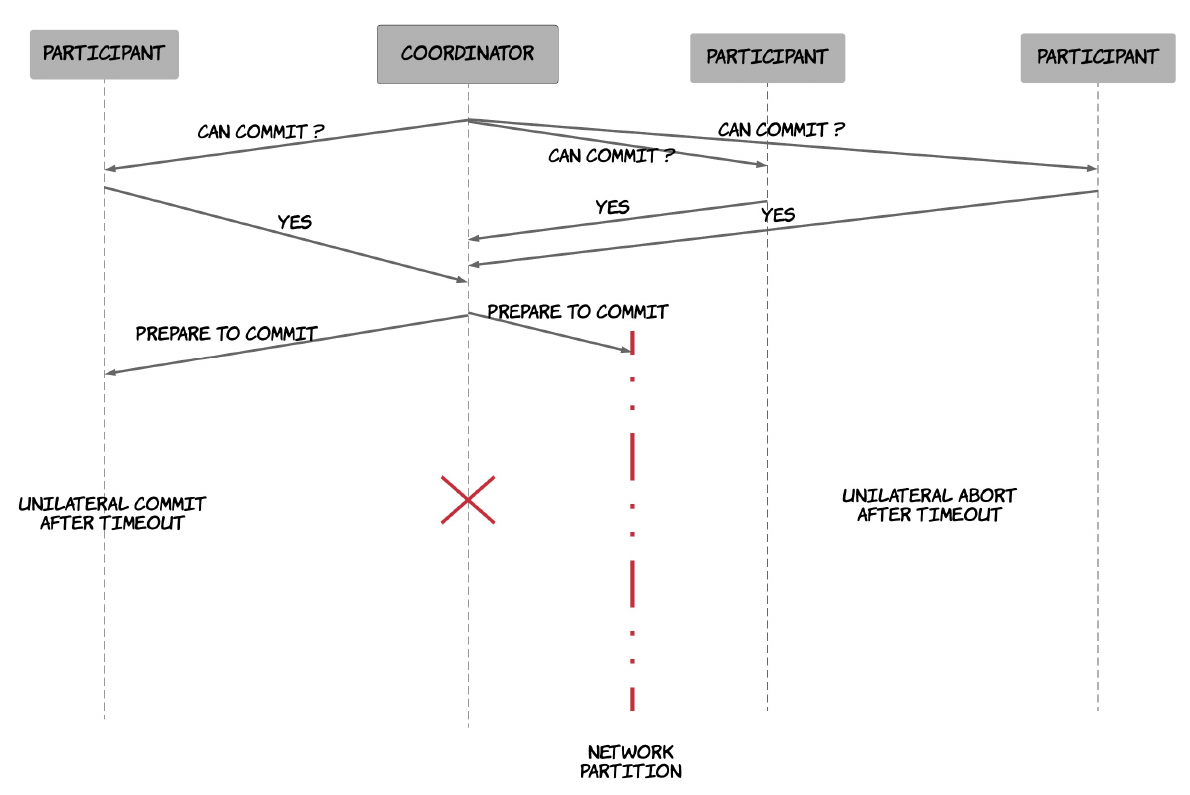
quorum-based commit protocol (extended 3PC)
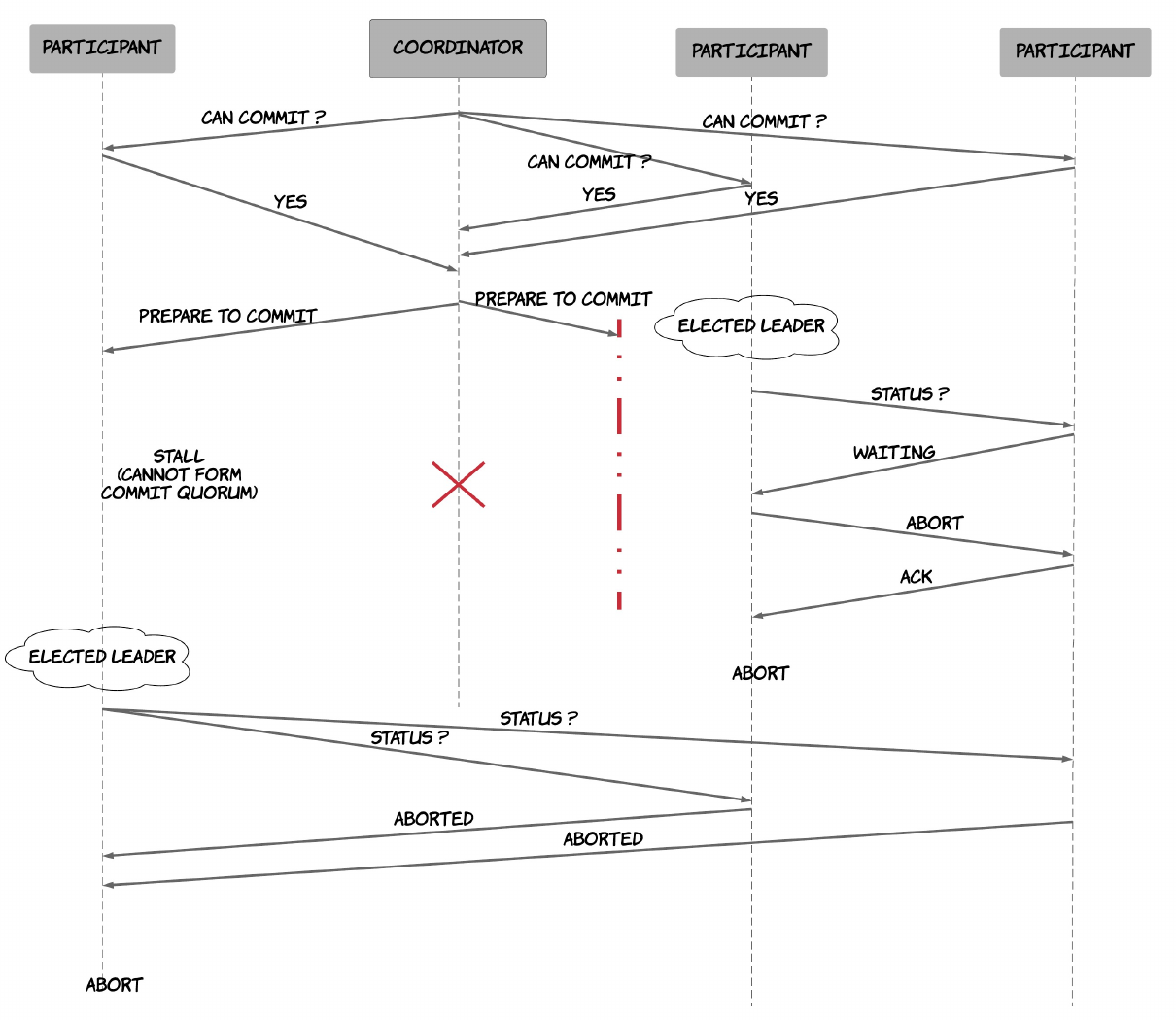
- address 3PC weakness (requires synchronous network and all participant availability) by using quorum
- quorum conditions (Skeen). the protocol is parameterized by a commit quorum Vc and an abort quorum Va:
Vc + Va > N-> the load-bearing rule. no set of nodes can gather a commit quorum while a disjoint set (e.g. on the other side of a partition) gathers an abort quorum -> the 2 decisions are mutually exclusive -> no split-brainVc > N/2is not required on its own; what is required is the intersection above (plus Va >= 1, Vc >= 1)- the prepare/pre-commit/commit rounds each wait for their target quorum before advancing
- 3 sub-protocols
- share a common state model and quorum intersection guarantees
- commit protocol
- similar to 3PC, wait target quorum in each phase
- coordinator waits commit quorum of ACK because of recovery protocol requirement
- for the recovery works correctly (participant queries a quorum of participants to determine transaction outcome), a quorum of participants must know the commit decision before coordinator considers transaction done
- termination protocol
- fires when a participant times out waiting for coordinator message. it elects a new coordinator, which queries peer states and must reach a quorum of responses — if it cannot, it stays blocked (this is the price of safety under partition)
- any COMMITTED -> COMMIT (terminal state already reached)
- any ABORTED -> ABORT (terminal state already reached)
- any PRE-COMMITTED (rest PREPARED) -> drive the PREPARED nodes to PRE-COMMIT, then COMMIT once Vc is reached
- all PREPARED, and an abort quorum Va is reachable -> ABORT
- all INIT -> ABORT
- fires when a participant times out waiting for coordinator message. it elects a new coordinator, which queries peer states and must reach a quorum of responses — if it cannot, it stays blocked (this is the price of safety under partition)
- merge/recovery protocol
- failed participant P recovers, finds an in-doubt transaction in its WAL, and queries a quorum of peers. same decision table as termination
- any COMMITTED -> COMMIT
- any ABORTED -> ABORT
- all PRE-COMMITTED -> COMMIT (a full prepare quorum was reached and coordinator had decided to commit)
- all PREPARED/INIT -> ABORT
- a node that cannot reach a quorum stays in-doubt and keeps its locks — it may not decide unilaterally
- failed participant P recovers, finds an in-doubt transaction in its WAL, and queries a quorum of peers. same decision table as termination
NORMAL PATH: COMMIT PROTOCOL
═══════════════════════════════════════════════════════════════════════════════

Coordinator        N1          N2          N3          N4          N5
    │               │           │           │           │           │
    │──── PREPARE ─────────────────────────────────────────────────>│
    │               │           │           │           │           │
    │<─── YES ──────│           │           │           │           │
    │<─── YES ──────────────────│           │           │           │
    │<─── YES ──────────────────────────────│           │           │
    │<─── YES ──────────────────────────────────────────│           │
    │                                                               │
    │   Qp=4 reached. Decide COMMIT.                                │
    │                                                               │
    │──── PRE-COMMIT ──────────────────────────────────────────────>│
    │               │           │           │           │           │
    │<─── ACK ──────│           │           │           │           │
    │<─── ACK ──────────────────│           │           │           │
    │<─── ACK ──────────────────────────────│           │           │
    │<─── ACK ──────────────────────────────────────────│           │
    │                                                               │
    │   Qpc=4 reached. Safe to commit.                              │
    │                                                               │
    │──── DO-COMMIT ───────────────────────────────────────────────>│
    │               │           │           │           │           │
    │<─── ACK ──────│           │           │           │           │
    │<─── ACK ──────────────────│           │           │           │
    │<─── ACK ──────────────────────────────│           │           │
    │<─── ACK ──────────────────────────────────────────│           │
    │                                                               │
    │   Qc=4 reached. Transaction DONE.                             │
    │                                                               │

Node states after commit protocol:
┌────┬────┬────┬────┬────┐
│ N1 │ N2 │ N3 │ N4 │ N5 │
│ CM │ CM │ CM │ CM │ PC │  CM=COMMITTED, PC=PRE-COMMITTED
└────┴────┴────┴────┴────┘
N5 missed DO-COMMIT (slow network). Coordinator re-drives or N5 self-recovers.


═══════════════════════════════════════════════════════════════════════════════
FAILURE PATH: TERMINATION PROTOCOL
(Coordinator crashes after Qpc reached, before sending DO-COMMIT)
═══════════════════════════════════════════════════════════════════════════════

Coordinator        N1          N2          N3          N4          N5
    │               │           │           │           │           │
    │──── PRE-COMMIT sent, Qpc=4 ACKed ────>│           │           │
    │                                                               │
    X  ← coordinator crashes here                                   │
                    │           │           │           │           │
                    │  timeout  │  timeout  │  timeout  │           │
                    │           │           │           │           │

All nodes: PRE-COMMITTED, waiting for DO-COMMIT. Timer expires.

─────────────────────────────────────────────────────────────────────────────
TERMINATION PROTOCOL FIRES
─────────────────────────────────────────────────────────────────────────────

                   N1 elected as new coordinator

New Coord(N1)      N1          N2          N3          N4          N5
    │               │           │           │           │           │
    │──── STATE? ──────────────────────────────────────────────────>│
    │               │           │           │           │           │
    │<─── PRE-COMMITTED ────────│           │           │           │
    │<─── PRE-COMMITTED ────────────────────│           │           │
    │<─── PRE-COMMITTED ────────────────────────────────│           │
    │                                                               │
    │  Quorum(4) all PRE-COMMITTED                                  │
    │  → PRE-COMMITTED proves commit decision was made              │
    │  → must COMMIT                                                │
    │                                                               │
    │──── DO-COMMIT ───────────────────────────────────────────────>│
    │               │           │           │           │           │
    │<─── ACK ──────────────────│           │           │           │
    │<─── ACK ──────────────────────────────│           │           │
    │<─── ACK ──────────────────────────────────────────│           │
    │<─── ACK ──────────────────────────────────────────────────────│
    │                                                               │
    │  Qc=4 reached. Transaction DONE.                              │

Node states after termination protocol:
┌────┬────┬────┬────┬────┐
│ N1 │ N2 │ N3 │ N4 │ N5 │
│ CM │ CM │ CM │ CM │ CM │
└────┴────┴────┴────┴────┘
Indistinguishable from commit protocol completing normally.


═══════════════════════════════════════════════════════════════════════════════
REJOIN PATH: RECOVERY PROTOCOL
(N3 was down during entire transaction, rejoins after termination completes)
═══════════════════════════════════════════════════════════════════════════════

                                       N3 recovers
                                       reads WAL → in-doubt transaction T
                                            │
                                            │──── STATE for T? ────> N1,N2,N4,N5
                                            │                              │
                                            │<─── COMMITTED ───────────────│ N1
                                            │<─── COMMITTED ───────────────│ N2
                                            │<─── COMMITTED ───────────────│ N4
                                            │<─── COMMITTED ───────────────│ N5
                                            │
                                            │  Quorum(4) all COMMITTED
                                            │  → write COMMITTED to WAL
                                            │  → release locks
                                            │  → done

Node states after recovery protocol:
┌────┬────┬────┬────┬────┐
│ N1 │ N2 │ N3 │ N4 │ N5 │
│ CM │ CM │ CM │ CM │ CM │
└────┴────┴────┴────┴────┘


═══════════════════════════════════════════════════════════════════════════════
RECOVERY: MIXED STATE CASE
(N3 recovers, finds peers in mixed PREPARED + PRE-COMMITTED state)
═══════════════════════════════════════════════════════════════════════════════

                                       N3 recovers, queries quorum
                                            │
                                            │──── STATE for T? ────> N1,N2,N4,N5
                                            │                              │
                                            │<─── PREPARED ────────────────│ N1
                                            │<─── PREPARED ────────────────│ N2
                                            │<─── PRE-COMMITTED ───────────│ N4
                                            │<─── PRE-COMMITTED ───────────│ N5
                                            │
                                            │  Mix seen. PRE-COMMITTED exists.
                                            │  → commit decision was made
                                            │  → N3 becomes new coordinator
                                            │  → drive remaining PREPARED nodes
                                            │    to PRE-COMMITTED first

New Coord(N3)                          N3        N1    N2    N4    N5
    │                                   │         │     │     │     │
    │──── PRE-COMMIT ───────────────────────────> │     │     │     │
    │                                             │     │     │     │
    │<─── ACK ─────────────────────────────────── │     │     │     │
    │<─── ACK ──────────────────────────────────────────│     │     │
    │                                                         │     │
    │  Qpc=4 reached (N1,N2,N4,N5)                            │     │
    │                                                         │     │
    │──── DO-COMMIT ───────────────────────────────────────────────>│
    │<─── ACK (all 4) ──────────────────────────────────────────────│
    │                                                               │
    │  Qc=4 reached. Transaction DONE.

Node states after recovery protocol:
┌────┬────┬────┬────┬────┐
│ N1 │ N2 │ N3 │ N4 │ N5 │
│ CM │ CM │ CM │ CM │ CM │
└────┴────┴────┴────┴────┘


═══════════════════════════════════════════════════════════════════════════════
HANDOFF MAP — HOW PROTOCOLS CHAIN
═══════════════════════════════════════════════════════════════════════════════

  COMMIT PROTOCOL
  ┌─────────────────────────────────────────────────────────────┐
  │  PREPARE → collect Qp → PRE-COMMIT → collect Qpc            │
  │  → DO-COMMIT → collect Qc → DONE                            │
  └──────────────────┬──────────────────┬───────────────────────┘
                     │ coordinator fails │ node fails
                     ▼                  ▼
  TERMINATION        │        RECOVERY PROTOCOL
  PROTOCOL           │        ┌──────────────────────────────────┐
  ┌──────────────────┴──┐     │  query quorum for state          │
  │  elect coordinator  │     │                                  │
  │  query peer states  │     │  COMMITTED    → apply commit     │
  │                     │     │  ABORTED      → apply abort      │
  │  COMMITTED  → COMMIT│     │  all PRE-CM   → drive termination│
  │  PRE-CM     → COMMIT│     │  all PREPARED → drive termination│
  │  PREPARED   → ABORT │     │  mixed        → drive termination│
  │                     │     └──────────────┬───────────────────┘
  │  drive to terminal  │                    │
  │  state via Qc ACKs  │                    │ if in-doubt
  └──────────┬──────────┘                    │
             │                               │
             └───────────────────────────────┘
             both produce terminal state (CM or AB)
             discoverable by future recovery quorum
             guaranteed by Qpc+Qc>N intersection


═══════════════════════════════════════════════════════════════════════════════
STATE DECISION MATRIX (used by both termination and recovery)
═══════════════════════════════════════════════════════════════════════════════

  Quorum response          Decision        Reason
  ──────────────────────── ─────────────── ───────────────────────────────────
  any COMMITTED            COMMIT          terminal state reached, match it
  any ABORTED              ABORT           terminal state reached, match it
  all PRE-COMMITTED        COMMIT          commit decision proven, drive it
  mix PREPARED+PRE-CM      COMMIT          PRE-CM proves decision, drive it
  all PREPARED             ABORT           no decision made, safe to abort
                                           (needs an abort quorum Va)
  all INIT                 ABORT           transaction never started

  SAFETY: "all PRE-COMMITTED -> COMMIT" and "all PREPARED -> ABORT" can never
  both fire, because Vc + Va > N forces the 2 quorums to intersect, and the
  node in the intersection cannot report both states.
- why “all PRE-COMMITTED -> COMMIT” is mandatory, not an optimization
N = 7, Vc = 4
coordinator sends DO_COMMIT to all 7, gets 3 ACK, then crashes

termination fires -> new coordinator sees a COMMITTED node -> issues COMMIT
now all COMMITTED nodes crash -> a later coordinator sees only PRE-COMMITTED

	- with the rule:    PRE-COMMITTED quorum -> COMMIT
	                    -> agrees with the 3 crashed nodes when they recover
	- without the rule: ABORT -> 4 ABORTED, 3 COMMITTED after recovery -> split brain

=> PRE-COMMITTED must be treated as proof that COMMIT was decided, even though
   no node ever observed the commit quorum Vc complete
- additional mechanisms for durability
- persistent WAL before ACK
- consensus underneath (raft/paxos): spanner (2PC over paxos)
long-lived transaction & saga
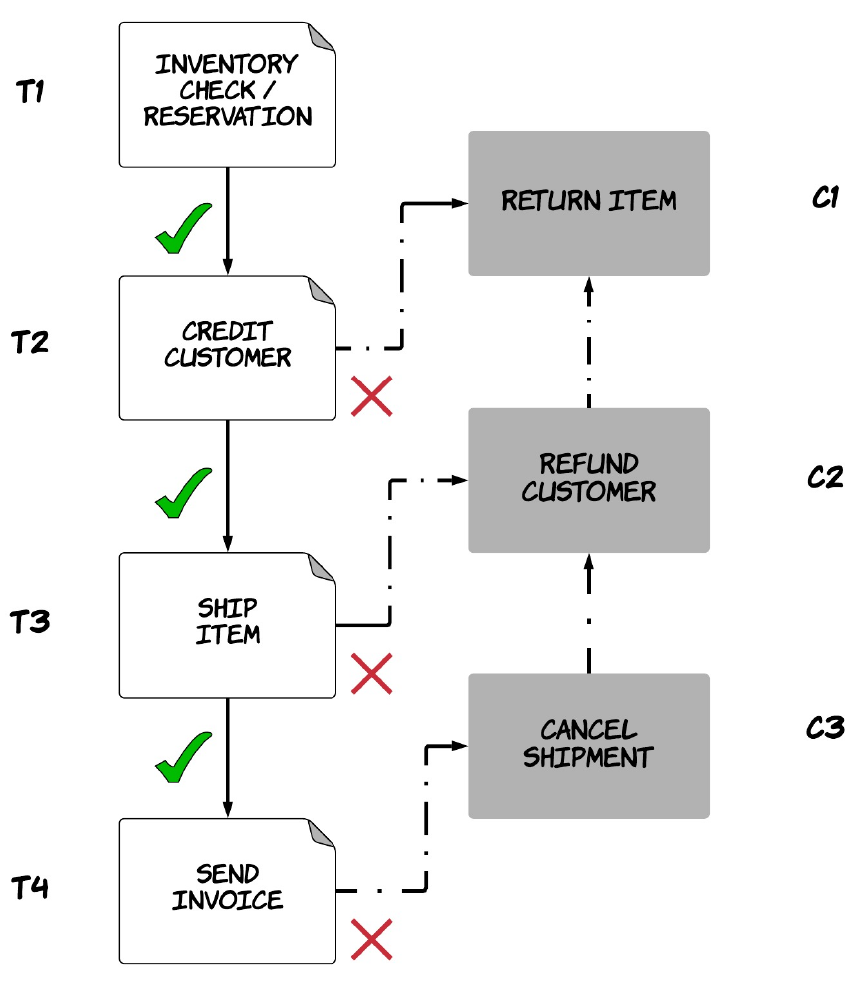
- saga is sequence of local transactions (trigger next transaction by message/event) that can be interleaved with other sagas with atomic guarantee. each of transaction T in saga is associated with compensating transaction C for rollback
- 2 execution models
- choreography
- no central coordinator, services listen event and react
- choreography
OrderService          PaymentService        InventoryService
     │                       │                      │
  T1: create order           │                      │
     │──── OrderCreated ────>│                      │
     │                    T2: charge card           │
     │                       │──── PaymentDone ────>│
     │                       │                   T3: reserve stock
     │                       │                      │──── StockReserved
     │                       │                      │
     │                       │    <── StockFailed ──│  (failure)
     │                       │                      │
     │          <── PaymentFailed ──────────────────│
     │                    C2: refund card           │
  C1: cancel order           │                      │
- orchestration
- central coordinator drives sequence of transactions
Orchestrator      OrderService   PaymentService   InventoryService
     │                 │               │                 │
     │──── T1 ────────>│               │                 │
     │<─── success ────│               │                 │
     │──── T2 ─────────────────────────│                 │
     │<─── success ────────────────────│                 │
     │──── T3 ──────────────────────────────────────────>│
     │<─── FAIL ──────────────────────────────────────── │
     │                 │               │                 │
     │──── C2 ─────────────────────────│                 │  compensate
     │<─── ACK ────────────────────────│                 │
     │──── C1 ────────>│               │                 │  compensate
     │<─── ACK ────────│               │                 │
     │                 │               │                 │
   DONE (compensated)
- drawbacks
- no isolation guarantee between concurrent sagas
- compensating transactions are not true rollback (the intermediate state was already visible to everyone)
- compensating transaction must be idempotent, commutative (concurrent compensations shouldn’t conflict), always possible (some operations cannot be compensated — an email already sent, a physical shipment)
when to use
- strong ACID across DB shards, same infra, short tx -> 2PC (with consensus underneath for HA)
- long-running business process across services -> saga
- non-blocking distributed commit -> 3PC/ quorum-based 3PC
consensus
-
all N nodes in distributed system agree on a single value v, satisfy these properties
- termination: every non-faulty node must eventually decide
- agreement: final decision of every non-faulty node must be identical
- validity: the value v must be proposed by one of the nodes
-
FLP impossibility it is IMPOSSIBLE for a deterministic consensus algorithm to guarantee all three simultaneously in an asynchronous system, even if only a single node may crash (the impossibility is about termination: a slow node and a dead node are indistinguishable without timing assumptions)
- practical algorithms escape it by giving up determinism (randomization) or pure asynchrony (timeouts / partial synchrony — what raft and paxos do). they keep safety always and get liveness only when the network behaves
paxos algorithm
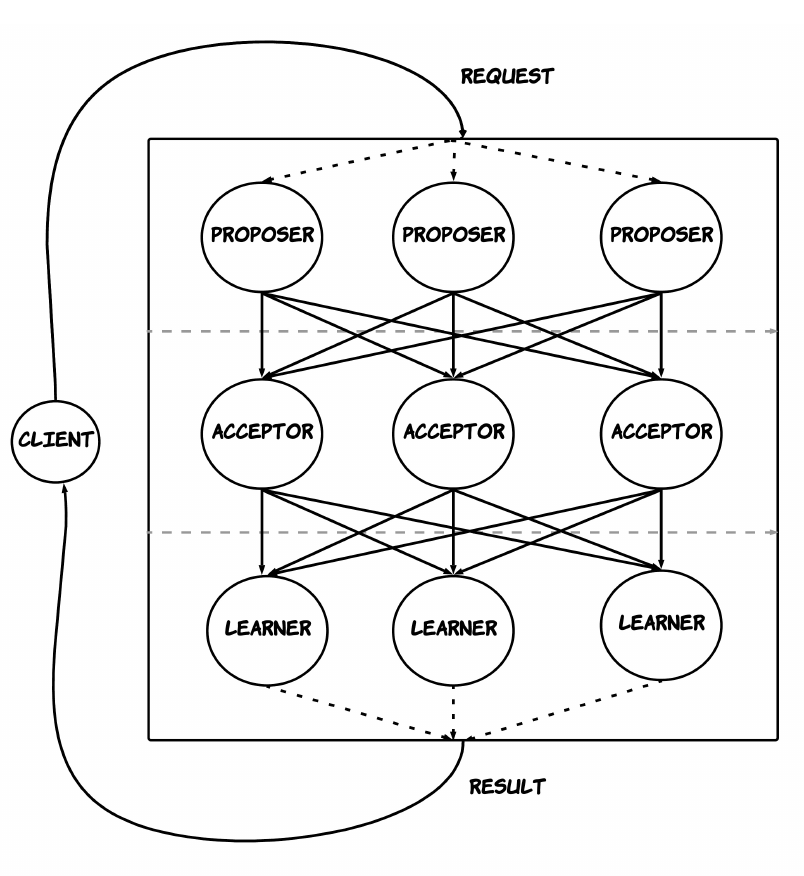
- system will come to an agreement, tolerating the failure of any number of nodes if more than half the nodes are working properly at any time
- 3 roles
- proposers
- propose values to the acceptors and persuade them to accept them
- acceptors
- receive proposals and reply their decisions
- learners
- keep outcomes of consensus, potentially act on them
- proposers
- algorithm
Phase 1a:  proposer picks n > any n it has used before
           sends prepare(n) to majority

Phase 1b:  acceptor receives prepare(n)
           if n > highest_promised:
               highest_promised = n
               reply promise(n, accepted_ballot, accepted_value)
           else:
               reject/ignore

Phase 2a:  proposer receives promise from majority
           if any promise has accepted_value != null:
               V = accepted_value from promise with highest accepted_ballot
           else:
               V = proposer's own value
           send accept(n, V) to majority (can be same or different majority)

Phase 2b:  acceptor receives accept(n, V)
           if n >= highest_promised:
               accepted_ballot = n
               accepted_value = V
               reply accepted(n, V)
           else:
               reject/ignore

Phase 3:   learner sees accepted(n, V) from majority → value V is chosen
raft
- establishes the concept of a replicated state machine and the associated replicated log of commands with multiple consecutive rounds of consensus
- 3 states
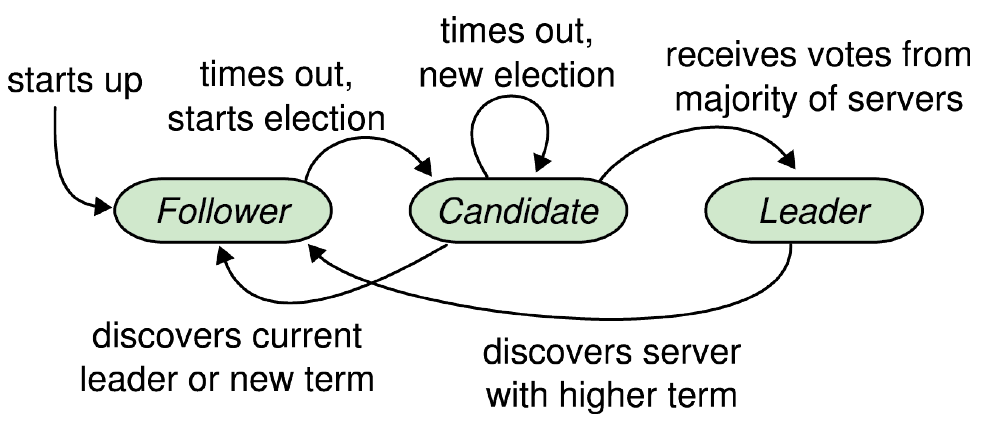
- leader
- receives proposals and replicates them to following nodes to reach consensus
- send heartbeats to other nodes to maintain its leadership
- fallbacks to follower if another node gains leadership
- follower
- candidate
- is middle state (follower -> leader) in leader election after original leader crashes
- leader
- use temporal terms to prevent 2 leaders operating concurrently. in each term, a candidate becomes the leader (receives votes from majority of nodes)
- an entry is committed if leader receives
appendresponses from majority of nodes AND the entry belongs to the leader’s current term- a leader may NOT commit an entry from a previous term just because it is now replicated on a majority (raft paper, figure 8: such an entry can still be overwritten by a future leader). those entries are committed indirectly, once an entry from the current term commits on top of them — the log matching property then makes all preceding entries committed too
- in practice a new leader appends a no-op entry in its own term to flush this out
- raft guarantees
- committed entries are durable and are executed eventually by all available state machines
- no 2 committed entries have same index
- if an entry is committed, all preceding entries are committed
- temporary divergence
- any elected leader has all committed entries up to term it becomes leader -> help followers converge (leader ONLY appends entries to its log, while followers can update them)
- followers must vote to candidate having more up-to-date log
time - order
- no global clock to order events happening on different nodes of distributed system
total/partial ordering
- total ordering is a binary relation that can be used to compare any 2 elements -> only 1 order for all elements
- partial ordering is a binary relation that can be used to compare only some of elements
causality
- causal consistency model ensures that events that are causally related are observed in a single order
lamport clock
- each node maintains a logical clock (numeric counter)
- increase C_i (C_i+1) before executing an event
- a node receives message with C_msg, C_i = max(C_i, C_msg), increase C_i by 1 and delivers message
- satisfies the clock condition (
Ei -> Ej => C_Ei < C_Ej) but NOT the strong clock condition (the converse fails):C_Ei < C_Ejtells you nothing, Ei and Ej may be concurrent -> cannot be used to infer causality
why merge THEN increment? (and why vector clock doesn’t care)
- on receive, lamport is forced into
C_i = max(C_i, C_msg) + 1. the+1MUST come last
receiver is behind: C_i = 2, message arrives with C_msg = 9

merge-then-increment:  max(2, 9) + 1 = 10        OK, 10 > 9
increment-then-merge:  max(2 + 1, 9) = 9         BROKEN, receive == send
-
the receive event would carry the same timestamp as the send event that caused it -> 2 causally ordered events with equal timestamps -> clock condition (which demands strict
<) is violated -
root cause: lamport collapses the whole vector into a single number, so that one number must do both jobs — absorb the sender’s knowledge (max) AND strictly advance past it (+1). only max-then-increment does both
-
vector clock has no such constraint: increment and merge touch disjoint slots, so they commute and either order gives the same vector
- node i only ever increments its OWN slot
C_i[i] - the merge can never change slot i:
C_j[i]is j’s belief about i’s counter, and j only ever learned it FROM i (directly or transitively) ->C_j[i] <= C_i[i]always ->max(C_i[i], C_j[i]) = C_i[i], a no-op - deeper reason: the merge alone already makes the receiver
>=the sender in EVERY slot, so the+1on its own slot is what makes it strictly greater. no single scalar has to carry both duties
- node i only ever increments its OWN slot
vector clock
- vector of N counters (N is number of nodes), clock of i-th node is
[C_i1, C_i2, ..., C_iN]
- increase C_ii (C_ii+1) before sending message
- when i-th node receives message from j-th node, increase C_ii by 1, for each k in 1..N, C_ik=max(C_ik,C_jk) and delivers message
- merge and increment commute here (see above) -> the order in the rule above is arbitrary, unlike lamport
- satisfies strong clock condition.
C_Ei < C_Ej <=> Ei -> Ej(causal relationship). incomparable vectors = concurrent events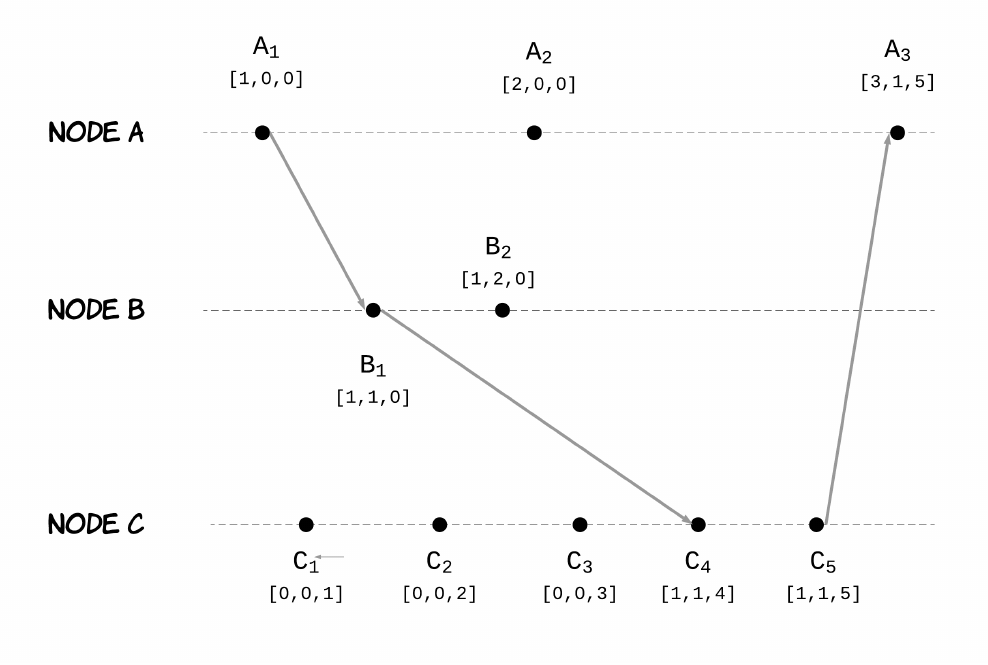
version vector
- every data item is tagged with a version vector in DB -> can be updated in multiple parts concurrently -> reconcile in conflict resolution
- for a data item x,
V[x]is a vector with one slot per node:V[x] = [v1, v2, ..., vN]
- all slots init to 0
- if i-th node updates x, it increases its OWN slot: V[x][i] += 1
- if i-th and j-th nodes sync x, both take the element-wise max over ALL slots:
      for each k in 1..N: V[x][k] = max(Vi[x][k], Vj[x][k])
- compare 2 version vectors of x: one dominates (>= in every slot) -> it is newer, discard the other. neither dominates -> concurrent updates -> conflict, hand to the resolver (siblings in dynamo/riak, LWW, app-level merge)
- vector clock tracks events per node, version vector tracks updates per replica of one data item — same math, different subject
version vector vs MVCC — NOT the same thing
- both keep multiple “versions”, but they solve different problems and are not used together in the usual case
| MVCC | version vector | |
|---|---|---|
| problem | isolation between concurrent transactions on one logical DB | conflict detection between concurrent writes on different replicas |
| ordering | a total order: monotonic txid / commit timestamp from a single authority | a partial order: concurrency is a first-class, detectable outcome |
| on 2 conflicting writes | one must abort (or block) — never a conflict left for the app | keep both as siblings, resolve later |
| where | postgres (xmin/xmax), mysql innodb, oracle | dynamo, riak, voldemort, cassandra-style multi-master |
- MVCC does not need a version vector because it has a single point of truth for time (the transaction id counter / commit timestamp), so every version is comparable -> a scalar suffices. version vectors exist precisely because leaderless/multi-master replication has no such authority
- distributed MVCC systems still use scalars, just better ones: spanner = TrueTime commit timestamps, cockroachdb/yugabyte = hybrid logical clocks (HLC = physical time + lamport counter). they buy back a total order rather than tracking causality per item
- so: MVCC -> scalar versions, single writer/authority. version vector -> causal versions, many writers