V8
- source code -> Ignition bytecode -> Sparkplug (machine code) -> Maglev/TurboFan (deoptimize to Sparkplug/Ignition if assumption fails) -> optimized code
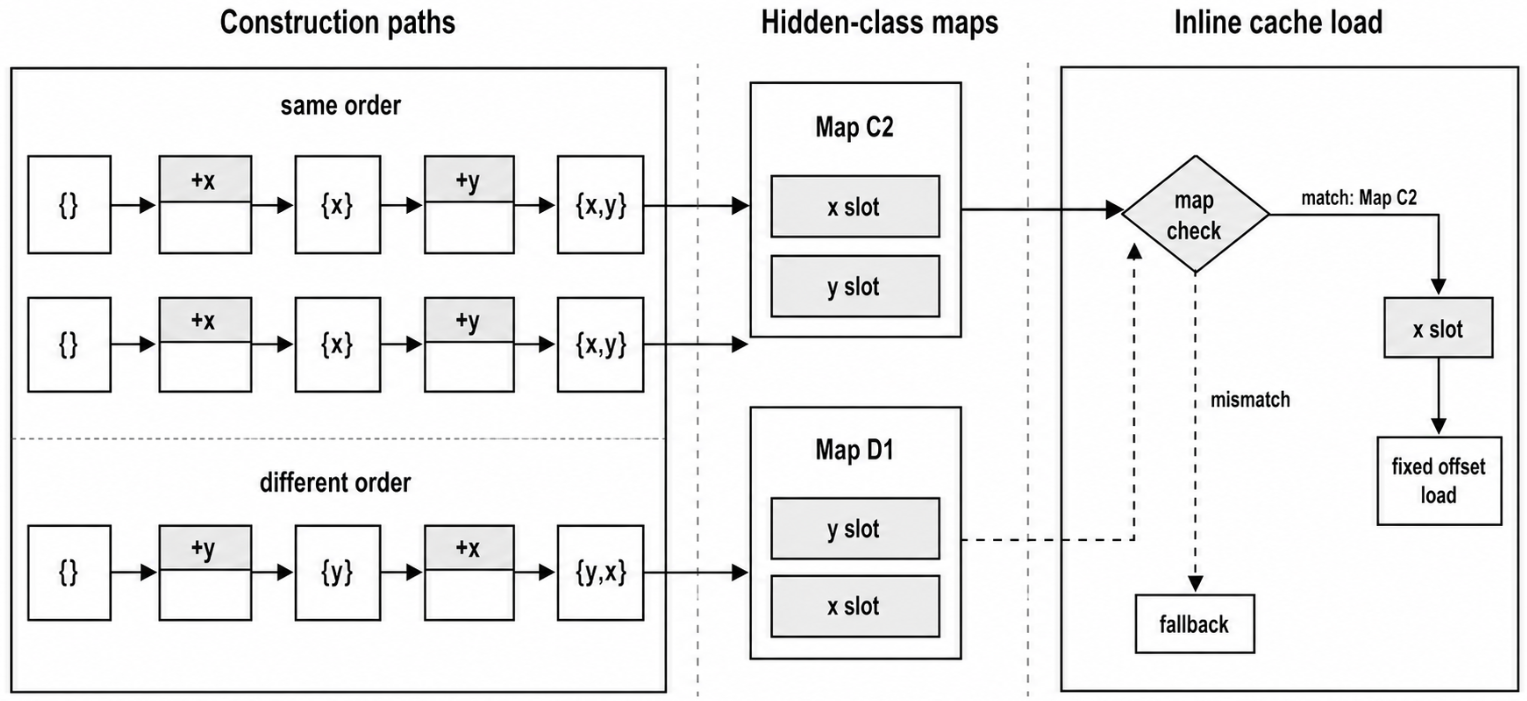
- optimize base on assumption of static object shape
- internal object layout - maps
- internal object layout - maps
// Run with: node —allow-natives-syntax hidden-classes-demo.js const obj1 = {}; const obj2 = {}; console.log(%HaveSameMap(obj1, obj2)); // true
obj1.x = 1; console.log(%HaveSameMap(obj1, obj2)); // false
obj2.x = 5;
console.log(%HaveSameMap(obj1, obj2)); // true
```
- transition trees
Event loop
Two-layer architecture: libuv (native engine — I/O, timers, thread pool) + Node scheduling rules (microtask queues). V8 only handles JS execution and GC.
Components
- V8: call stack, heap, GC — no I/O or timers
- libuv: epoll (linux) / kqueue (mac) / IOCP (windows); worker thread pool default 4 threads (
UV_THREADPOOL_SIZE); servesfs,crypto.pbkdf2,dns.lookup, zlib - C++ bindings: bridge between V8 and libuv
Blocking the event loop = any long-running synchronous work on the call stack; no queued callback can interrupt it.
Event loop phases
 ┌─────────────────────────────────┐
 │           timers                │  setTimeout / setInterval
 │                                 │  delay = minimum threshold, not guarantee
 ├─────────────────────────────────┤
 │       pending callbacks         │  I/O errors deferred from prior iteration
 ├─────────────────────────────────┤
 │        idle / prepare           │  libuv internal bookkeeping only
 ├─────────────────────────────────┤
 │            poll                 │  I/O events; epoll/kqueue/IOCP
 │                                 │  calculates wait time from pending timers
 │                                 │  if setImmediate pending → skip to check
 ├─────────────────────────────────┤
 │            check                │  setImmediate callbacks
 ├─────────────────────────────────┤
 │       close callbacks           │  socket.destroy() "close" events
 └────────────┬────────────────────┘
              │ any referenced handles/timers left?
              │  yes → next iteration   no → process exits
After every callback returns → drain nextTick queue → drain V8 microtask queue → advance to next phase.
Microtask priority queues
| Queue | API | Priority | Notes |
|---|---|---|---|
| next tick | process.nextTick() | 1st | ”Legacy”; recursive use starves I/O |
| V8 microtasks | Promise .then/catch/finally, queueMicrotask(), async/await | 2nd |
  [callback returns]
    1. drain ALL nextTick  (including new ones added during drain)
    2. drain ALL microtasks (including new ones added during drain)
    3. move on

  A concrete proof:

  Promise.resolve().then(() => {
    console.log("microtask 1");
    process.nextTick(() => console.log("nextTick (nested inside microtask)"));
    Promise.resolve().then(() => console.log("microtask 2 (nested)"));
  });

  process.nextTick(() => {
    console.log("nextTick 1");
    process.nextTick(() => console.log("nextTick 2 (nested)"));
  });

  // Output:
  // nextTick 1
  // nextTick 2 (nested)     ← nested nextTick still runs before any microtask
  // microtask 1
  // nextTick (nested inside microtask)  ← nextTick added during microtask drain...
  // microtask 2 (nested)    ← ...runs before the next microtask
Execution order by context:
- CJS top-level: stack → nextTick → microtasks → event-loop phases
- Phase callback: callback → nextTick → microtasks → next phase
- ESM top-level: module evaluation is a microtask — promises can run before
process.nextTick()
console.log("1. Start");
Promise.resolve().then(() => console.log("4. Promise"));
process.nextTick(() => console.log("3. nextTick"));
fs.readFile(__filename, (err) => {
  console.log("5. I/O Callback");
  setTimeout(() => console.log("9. Timeout from I/O"), 0);
  setImmediate(() => console.log("8. Immediate from I/O"));
  process.nextTick(() => console.log("6. nextTick from I/O"));
  Promise.resolve().then(() => console.log("7. Promise from I/O"));
});
console.log("2. End");

// 1. Start          — sync
// 2. End            — sync
// 3. nextTick       — stack cleared → drain nextTick
// 4. Promise        — drain V8 microtasks
// 5. I/O Callback   — poll phase
// 6. nextTick from I/O  — I/O returns → drain nextTick
// 7. Promise from I/O   — drain microtasks
// 8. Immediate from I/O — check phase
// 9. Timeout from I/O   — timers phase (next iteration)
setTimeout vs setImmediate
- From main script: unpredictable — timer threshold may or may not have passed
- From inside I/O callback:
setImmediatealways first — poll phase finishes, check phase is next; timer phase comes after
What blocks the event loop
fs.readFileSync()and other sync APIsJSON.parse()on large payloads- Regex with catastrophic backtracking
- Heavy CPU loops without yielding
Worker pool (libuv threads) is shared — a slow fs op competes with crypto.pbkdf2; default 4 threads is a common bottleneck under concurrency.
CPU-bound solutions
| Approach | Mechanism | Use case |
|---|---|---|
setImmediate() chunking | yields between batches, same thread | improve responsiveness without true parallelism |
worker_threads | own V8 isolate + event loop per worker | true parallelism; data cloned or transferred |
cluster | multiple Node processes sharing ports | horizontal scale across CPU cores |
Monitoring event loop lag
// basic
let last = Date.now();
setInterval(() => {
  const lag = Date.now() - last - 1000;
  if (lag > 50) console.warn(`EL lag: ${lag}ms`);
  last = Date.now();
}, 1000);

// production
const { monitorEventLoopDelay } = require("node:perf_hooks");
const h = monitorEventLoopDelay({ resolution: 10 });
h.enable();
// h.mean, h.percentile(99), etc.
V8 GC stop-the-world pauses are indistinguishable from blocking code and contribute to tail latency spikes under memory pressure.
Buffer
Stream
Async pattern
error-first callback
try/catch
- try/catch only protects the stack that is running right now
try {
  fs.readFile("/nonexistent", "utf8", (err, data) => {
    console.log(data.trim()); // -> error
  });
} catch (err) {}
promise
- a promise starts as pending, goes fulfilled/rejected (irreversible); tracked via internal
[[PromiseState]]/[[PromiseResult]] - executor runs synchronously;
.then/.catch/.finallyhandlers always deferred to microtask queue - resolution vs settlement: resolving with another promise makes the outer promise follow that promise’s state (not wrap it); thenables go through
PromiseResolveThenableJob— one extra microtask turn vs a plain value - chaining: each
.then()returns a new promise; handler return value determines next settlement- normal return → fulfills next
- thrown error → rejects next
- returned promise → next follows that promise
- error propagation: rejection travels down the chain until a handler catches it; fulfillment-only handler is skipped;
.catch()returning a value recovers the chain - unhandled rejection: Node v24 default
--unhandled-rejections=throw(treats as uncaught exception);unhandledRejection/rejectionHandledprocess events track lifecycle util.promisify()wraps error-first callbacks; multi-value functions needutil.promisify.custom;util.callbackify()reverses direction- starvation: unbounded microtask recursion starves I/O — use
setImmediate()between large independent batches - memory: every
.then()allocates a promise; handler closures can retain large buffers — profile heap under concurrency
Combinators — operate on already-started promises; they don’t cancel, retry, or limit concurrency:
| Combinator | Fulfills when | Rejects when | Use case |
|---|---|---|---|
Promise.all(arr) | all fulfill | first rejection | need every result; one fail = all fail |
Promise.allSettled(arr) | all settle (never rejects) | — | batch ops; collect all outcomes |
Promise.race(arr) | first to settle | first to settle | timeout racing; losers keep running |
Promise.any(arr) | first fulfillment | all reject → AggregateError | redundant mirrors / fallbacks |
// all — ordered results regardless of completion sequence
const [user, posts] = await Promise.all([fetchUser(id), fetchPosts(id)]);

// allSettled — inspect each outcome
const results = await Promise.allSettled([...]);
for (const r of results) {
  if (r.status === "fulfilled") use(r.value);
  else logError(r.reason);
}

// race — timeout pattern (does NOT cancel the loser)
const res = await Promise.race([fetch(url), timeout(5000)]);

// any — first CDN to respond wins
const data = await Promise.any([fetch(cdn1), fetch(cdn2), fetch(cdn3)]);
Concurrency limiting:
async function pMap(items, fn, concurrency) {
  const results = new Array(items.length);
  let nextIndex = 0;
  async function worker() {
    while (nextIndex < items.length) {
      const i = nextIndex++;
      results[i] = await fn(items[i], i);
    }
  }
  await Promise.all(
    Array.from({ length: Math.min(concurrency, items.length) }, worker),
  );
  return results;
}
Retry with exponential backoff:
async function retry(
  fn,
  { maxRetries = 3, baseMs = 1000, shouldRetry = () => true } = {},
) {
  for (let attempt = 0; attempt <= maxRetries; attempt++) {
    try {
      return await fn();
    } catch (err) {
      if (attempt === maxRetries || !shouldRetry(err)) throw err;
      const delay = baseMs * 2 ** attempt * (0.5 + Math.random() * 0.5);
      await new Promise((r) => setTimeout(r, delay));
    }
  }
}
// wrap functions, not promises: retry(() => fetch(url))
// only retry transient: 429, 503, timeouts — not 4xx auth/input errors
Timeout with AbortSignal:
async function fetchWithTimeout(url, ms, options = {}) {
  const signal = options.signal
    ? AbortSignal.any([options.signal, AbortSignal.timeout(ms)])
    : AbortSignal.timeout(ms);
  return fetch(url, { ...options, signal });
}
async/await
- syntactic sugar over promise chains; each
await≈ a.then()continuation - code before the first
awaitruns synchronously on the caller’s stack - at an
await: V8 saves locals + bytecode position to heap (JSAsyncFunctionObject), enqueues aPromiseReactionJob, returns control; resumes when awaited promise settles - the outer promise (returned to caller) is the single caller-facing result across all suspension points
Execution ordering (same rules as microtasks):
// CJS: nextTick drains before V8 microtasks
// ESM: top-level runs inside microtask drain — order may differ
return vs return await in try/catch:
// BAD — rejection escapes try/catch because fn() returns before promise settles
async function bad() {
  try { return fn(); } catch(e) { ... }
}
// GOOD — keeps execution inside try/catch until settled
async function good() {
  try { return await fn(); } catch(e) { ... }
}Anti-patterns:
// floating promise — rejection is lost
async function bad() {
  doAsync();
}

// forEach ignores returned promises — loop ends before work completes
urls.forEach(async (url) => {
  await fetch(url);
});

// accidental serialization — sequential awaits for independent work
for (const u of users) {
  await sendEmail(u);
} // slow!
// fix: await Promise.all(users.map(u => sendEmail(u)))Memory: suspended functions retain all in-scope locals — null out large buffers before long waits:
async function handle(req) {
  let body = await readBody(req);
  const parsed = parse(body);
  body = null; // release before next await
  return db.save(parsed);
}
Bounded concurrency for large batches:
for (let i = 0; i < items.length; i += 100) {
  await Promise.all(items.slice(i, i + 100).map(transform));
}
event emitter
- synchronous listener registry —
emit()runs listeners on the current call stack in registration order; slow listeners block everything that follows - internal
_eventsuses a null-prototype object (no inherited-property collisions); single listener stored as function, multiple as array
Registration:
on()/addListener()— append to endprependListener()— insert at frontonce()— auto-removes after first fire (but persists if event never fires)off()/removeAllListeners()— explicit cleanup; required for listeners on long-lived objects to avoid leaks
Special "error" event: if emitted with no listener → throws and crashes process; always attach an "error" listener to sockets, streams, servers
Max-listener warning (default 10/event): signals repeated on() without cleanup, typically from per-request patterns on long-lived emitters
Modern integration:
import { once, on } from "node:events";

// one-shot — returns a promise
const [data] = await once(ee, "data");

// async iteration — buffers events, consumer-paced
for await (const [msg] of on(ee, "message")) {
  console.log(msg);
}
// both support AbortSignal for timeout/cancellation
When to use each pattern:
| Pattern | Use case |
|---|---|
| Callback | single result, legacy API |
| Promise / async-await | single async result |
events.once() | wait for one event as a promise |
EventEmitter .on() | repeated push-based notifications |
Async iterator / events.on() | consumer-paced stream of events |
async iterators
- protocol: object exposes
[Symbol.asyncIterator]()returning{ next() → Promise<{value, done}> } for await...of: callsnext(), awaits, loops untildone: true; on break/throw calls iterator’sreturn()for cleanup (closes file handles, destroys streams)- inherently sequential — 100 items × 500 ms = 50 s minimum
Async generators (async function*):
async function* fetchPages(url) {
  for (let page = 1; ; page++) {
    const data = await fetch(`${url}?page=${page}`).then((r) => r.json());
    if (!data.items.length) return;
    yield data.items; // pauses until consumer calls next()
  }
}
// await = wait for external I/O; yield = wait for consumer
Readable streams implement Symbol.asyncIterator; for await...of naturally respects backpressure — next chunk requested only after current one is processed. Early exit calls destroy() by default; use readable.iterator({ destroyOnReturn: false }) to preserve the stream.
events.on() adapter: buffers emitted events in an (effectively unbounded) queue for async consumption — beware memory growth if emitter outpaces consumer:
for await (const [msg] of on(ee, "message", { signal })) { ... }
// use streams or custom queues with limits for high-throughput sources
Pipeline with backpressure:
async function* map(source, fn) { for await (const x of source) yield fn(x); }
async function* filter(source, pred) { for await (const x of source) if (pred(x)) yield x; }
for await (const item of filter(map(source, transform), predicate)) { ... }
Adding concurrency inside for await:
const batch = [];
for await (const item of source) {
  batch.push(process(item));
  if (batch.length >= BATCH_SIZE) {
    await Promise.all(batch);
    batch.length = 0;
  }
}
await Promise.all(batch);