introduction
- 3 concerns
- reliability: the system should work correctly even in the face of adversity (faults, errors, …) -> fault tolerance/resilient
- scalability: there should be reasonable ways of dealing with the growth of data, traffic, … (~ a system’s ability to cope with increased load)
- performance
- when increase load parameters and keep system’s resources unchanged, how is the performance affected?
- when increase load parameters, how much need to increase system’s resources to keep the performance unchanged?
- metric
- average response time of service -> percentiles -> know how long users typically have to wait
- high percentage of response time (tail latencies) -> affect user’s experience of service
- SLO (service level objectives)
- SLA (service level agreements)
- service is up if median (p50) response time less than 200ms and 99th percentile (p99) under 1s
- cope with load
- scaling up (vertical) / out (horizontal)
- performance
- maintainability
data models and query languages
- relational vs document model
- relational
- data is organized in relations (tables) and each relation is an unordered collection of tuples (rows)
- theoretical proposal
- schema-on-write (structure is explicit)
- query optimizer decides which parts of query to execute first and which indexes to use
- nosql
- greater scalability (very large dataset, very high write throughput, …)
- dynamic and expressive data models
- schemaless -> schema-on-read (structure is implicit)
- need more work to keep data consistency (in many-to-many relationship)
- many-to-one, many-to-many relationships
- if something has no meaning to human, it never needs to change (ie. id). something is meaningful to human, it may be changed in the future -> write overhead, inconsistencies, …
- relational
- mapreduce
storage and retrieval
- storage engines are optimized for transactional workloads and analytics?
index
- find the value for a particular key more efficient
- additional data structure, that is derived from the primary data
hash index
- lots of writes (per key), but not many distinct keys (keep all keys in memory)
- split to segments, each segment has its own in-memory hash table
- append-only design is good at
- sequential write operations are much faster than random writes
- concurrency and crash recovery are much simpler if segment files are append-only or immutable
- avoid data fragmentation over time
SSTables
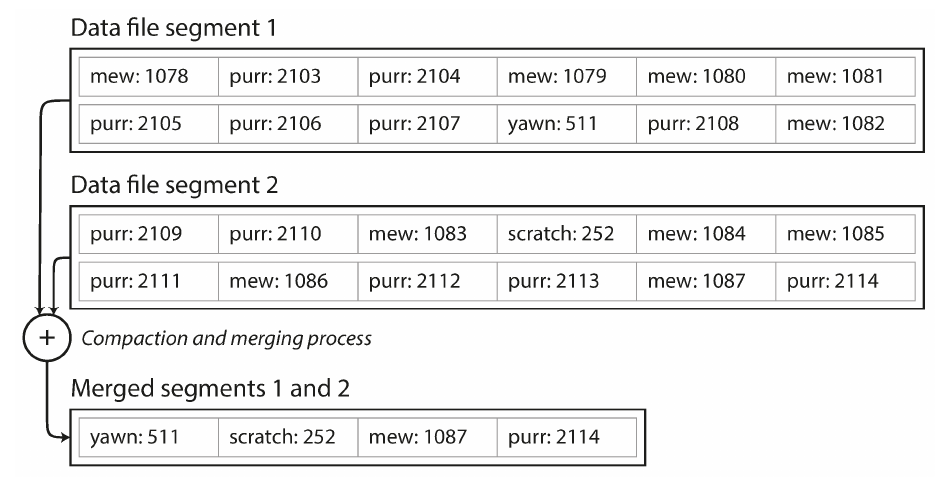
- each log segment is a sequence of key-value pairs, later value overwrites previous values of same key
- sequence of key-values pairs is sorted by key
- each key appears once within each merged segment file
- construction
- red-black tree/AVL tree -> insert keys in any order and read them in sorted order
- advantages
- merging segments is simple and efficient (similar to mergesort). if same key appears in several input segments -> keep value from most recent segment and discard others
- jump and scan key without exact offset of key in segment (due to sorted keys) -> sparse in-memory index
- group records to block before writing to disk -> reduce IO
- disadvantages
- if database crashes, the most recent writes (in memtable, not disk) are lost -> keep logs on disk (without ordering for crash backup)
LSM-tree
- used in embedded key-value storage engine like RocksDB, LevelDB,
- based on principle of merging and compacting sorted files
- support high write throughput applications
- use Bloom filter for optimizing data access -> check key doesn’t exist
- the order and timing how SSTables are compacted and merged
- size-tiered
- newer and smaller SSTables are merged into older and larger SSTables
- leveled
- split up into smaller SSTables and older data is moved into separate levels
- size-tiered
- split data into variable-size segments
B-Tree
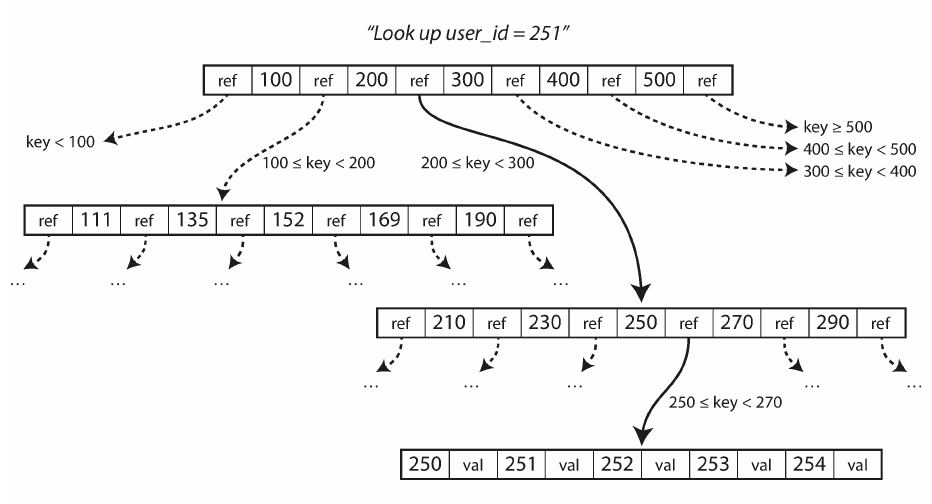
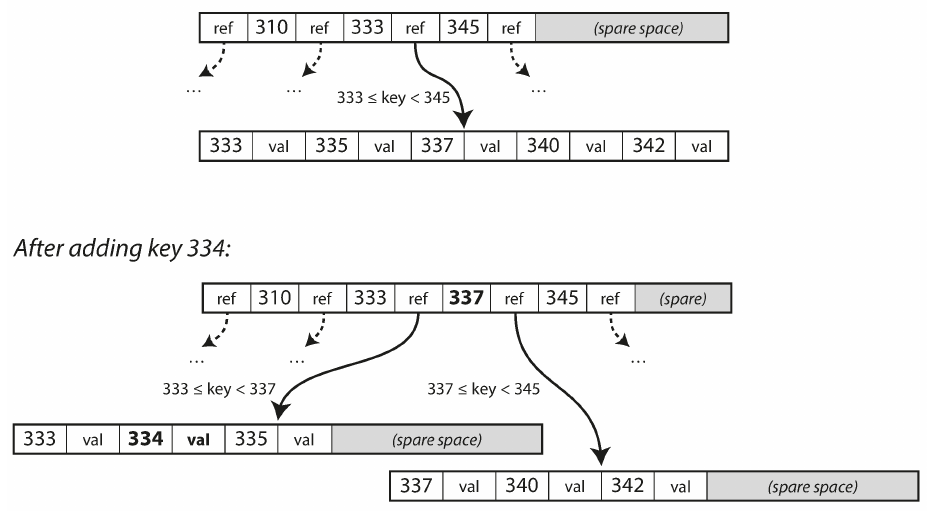
- split data into fixed-size segments (page size)
- B-tree with n keys always has a depth of O(logn) -> most of databases can fit into 3 or 4 levels depth
- the overwrite data doesn’t change the location of page (ref), different from LSM (append only)
- implement write-ahead log (WAL) (append-only before modify tree itself) to make database more resilient to crashes
- B-tree index key locates in exactly one place in the index, whereas LSM can store multiple copies of the same key in different segments
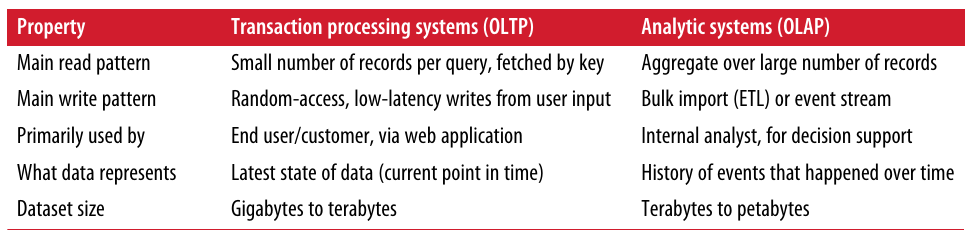
difference between online transaction processing (OLTP) - online analytic processing (OLAP)
column-oriented storage - todo
encoding - todo
JSON, XML, binary variants
thrift, protobuf, avro: binary encoding
- requires a schema for any data
asynchronous message passing dataflow
- message broker
- sends a message to a named queue/topic, and ensures that the message is delivered to consumers/subscribers to that queue/topic -> one-way dataflow