- is algorithm allow multi processes to reach to agreement on a value -> putting events in a particular order and ensuring consistency among the participants
broadcast
- a communication abstraction in distributed system to disseminate information among a set of processes
- reliable broadcast guarantees that all correct processes receive the same message -> use fallback mechanism and failure detector
atomic broadcast - total order multicast
- it guarantees both reliable delivery and total order of messages = same messages and same sequences of messages
- atomicity
- either all non-failed processes deliver/agree on set of messages or none do
- order
- all non-failed processes deliver messages in the same order
virtual synchrony
- it delivers totally ordered messages to dynamic group of peers -> processes can see identical messages (order) only as long as they belong to same group
- it distinguishes message receipt (when a group member receives the message) and delivery (which happens when all member receive the messages). If the message was sent in one view (group members change), it can be delivered only in the same way
- all messages are sent and delivered between the view changes.
zookeeper atomic broadcast (ZAB)
- it has 2 roles leader (the temporary role to broadcast messages and establishes the order) and follower
- timeline is split into epochs. in each epoch, there is only one leader (using election)
- after a prospective leader is established, there are 3 phases
- discovery
- the leader proposes new epoch (greater than current epoch of any follower) -> no proposal of earlier epoch is accepted
- in failure path, if the leader node crashes, node with highest/latest transaction id will be elected as the new leader
- synchronization
- the system recovers from previous leader’s failure and brings lagging followers up to speed.
- the leader proposes itself as the new leader and collects acknowledge from followers -> not accept follower’s attempt to become new leader
- broadcast
- the leader receives client messages, establish their order and broadcast them to followers (waits for a quorum then commit)

- the leader receives client messages, establish their order and broadcast them to followers (waits for a quorum then commit)
- discovery
- it ensures that followers accept proposals from the leader of established epoch and messages are totally ordered (leader doesn’t attempt to send next message until the message is acknowledged)
- ZAB is efficient. the broadcast process requires 2 rounds of messages, and leader failure can be recovered from streaming missing messages from a single up-to-date process
paxos
- it includes 3 roles, any participant can take any role
- proposers receive values from clients, create proposals and collect votes from acceptors
- acceptors accept/reject proposals
- learners store outcomes of accepted proposals
paxos algorithm
-
it includes 2 phases
- prepare/promise
- prepare: proposer send proposal number N in
Prepare(N)to quorum of acceptors - promise:
- if N is larger than any proposal number it has seen -> ignore all future proposals with number less than N
- if acceptor has accepted any proposal before
Accept(m,v), it returnsPromise(m,v)to proposer
- prepare: proposer send proposal number N in
- accept(propose)/accepted
- propose:
- if proposer receives
Promise(m,v)-> proposer adopts the value with highest proposal number (safety guarantee). The proposer must abandon its own value (effectively lost/discarded) and propose the value with highest proposal number - if no values were returned, proposer selects its own value
- proposer send
Accept(N,value)to acceptors -> once value reaches a quorum, every subsequent successful round of Paxos will choose this value.
- if proposer receives
- accepted
- if acceptor receives
Accept(N,value)and doesn’t ignore proposal N (has seen larger value), it accepts proposal N and notifies learners (to store value)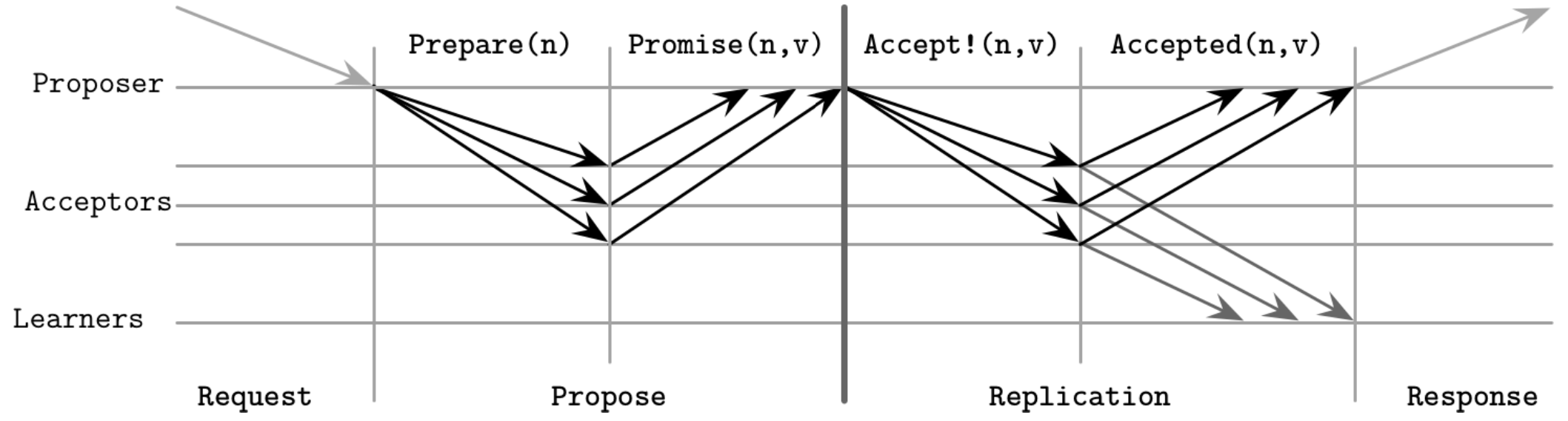
- if acceptor receives
- propose:
- prepare/promise
-
failure cases
- a value is accepted by minority -> it will be overwritten
- a value is accepted by majority (quorum) -> it will be proposed again, and proposer is forced to complete it
- a value is accepted by majority, but some of these acceptors in next quorum crash
- with persistence, the system works perfectly
- without persistence, the system violates consistency
multi-paxos
- a distinguished proposer as leader to skip prepare/promise phase. Only new proposer has to perform this phase
- use leases: the leader periodically contacts to participants, and they must respond and allow the leader to continue operation (not accept proposals from other leaders in period of lease)
fast paxos
- it reduces latency by allowing client sends its value to acceptors directly (reduce network hop - leader)
- it needs fast quorum (~75% of nodes) to handle collisions
flexible paxos
- it needn’t majority but prepare quorum and accept quorum must share at least one node
| Feature | Classic Paxos | Fast Paxos | Flexible Paxos |
|---|---|---|---|
| Primary Goal | Consistency | Lower Latency | Grid Scalability |
| Network Hops | 2 (Client-Leader-Nodes) | 1 (Client-Nodes) | 2 (Standard) |
| Quorum Size | Simple Majority () | Fast Quorum () | Custom () |
| Best Use Case | General purpose | Low-latency local networks | Massively distributed systems |
raft
-
3 roles
- candidate: a temporary state. a participant must be a candidate before it becomes the leader by collection a majority of votes
- leader: handles client requests and interacts with replicated state machine in period of time, called term
- follower: persists log entries and responds to requests of leader/candidate (is acceptor/learner of paxos). every process begins as a follower
=> candidate -> leader: voting => follower -> candidate: election timeout (not receiving leader’s heartbeats in a randomized period of time - randomized timeout). raft uses randomized timeout to prevent split votes (most/all of nodes become candidates)
-
time is divided into terms (epochs). during it, leader is unique and stable
raft algorithm
-
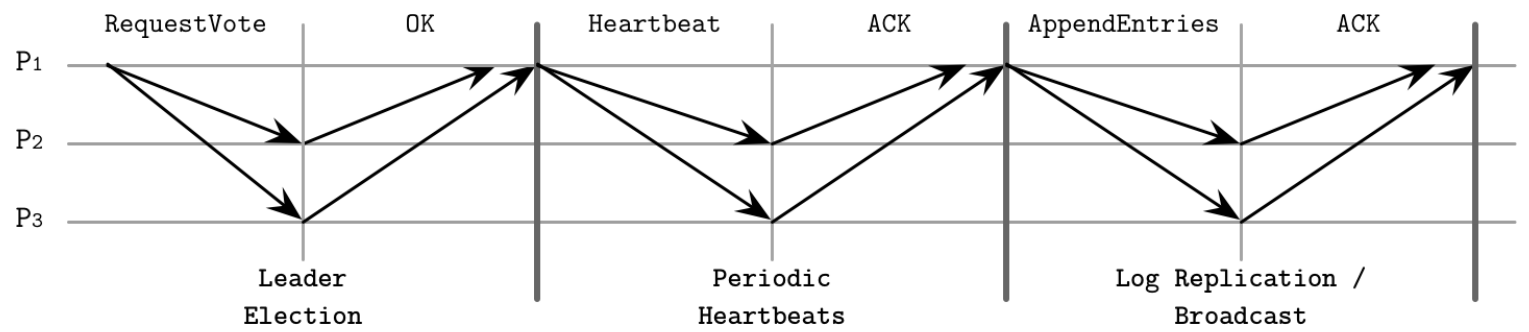
3 phases
- leader election: a candidate collects a majority of votes to become new leader
- periodic heartbeats: the leader periodically sends heartbeats to maintain its term
- replication/broadcast
-
failure scenarios
- split vote: no candidate collects a majority of votes
byzantine consensus - practical byzantine fault tolerance (PBFT)
- for both safety and liveness, no more than (N-1)/3 replicas can be faulty
- PBFT uses view to distinguish cluster configurations (1 replica is primary and the rest are backups)
- 3 phases
- pre-prepare: the primary sends prepare message (with view id, …)
- prepare: the backup accepts prepare message if its view matches view of the primary
- commit: the primary broadcasts commit message and waits
2f+1messages from participants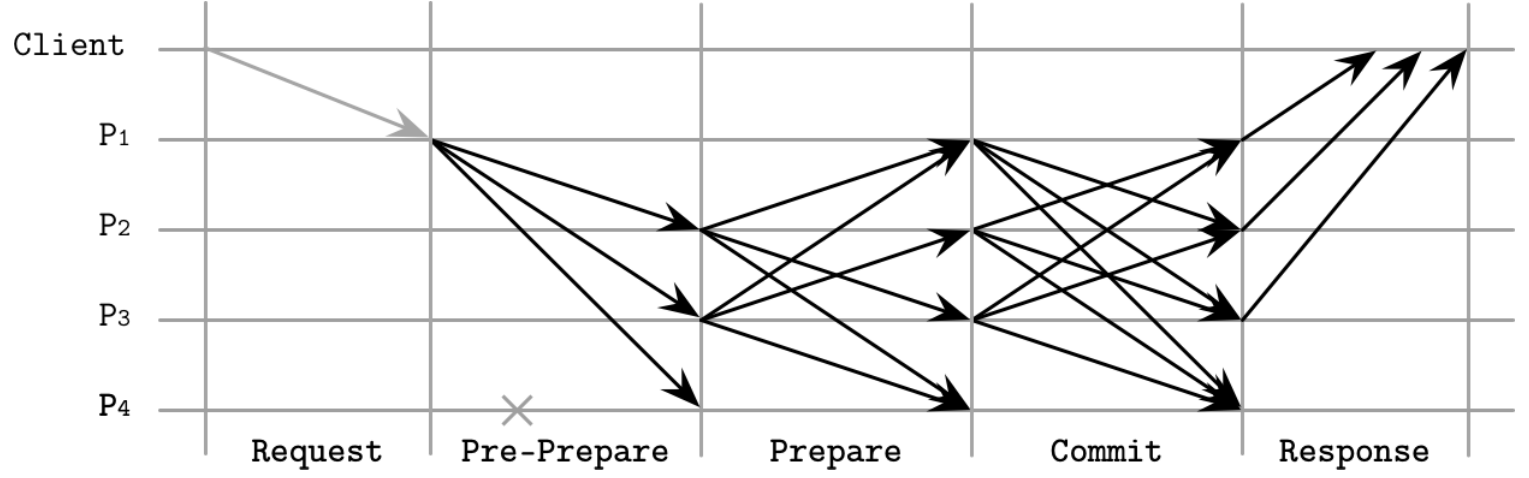
paxos vs raft
- paxos: mathematical flexibility and decentralization
- raft: structural rigidity and predictable flow